

I have spent too many mornings staring blankly at my desk, completely paralyzed by how much needed to be done. Client projects collided with simple domestic chores, routine decisions felt exhausting, and daily commitments just kept piling up. Even straightforward tasks suddenly felt crushing, leading straight to procrastination and scattered focus.
That friction is not a character flaw or a lack of discipline. It is the predictable outcome of severe mental overload when you are feeling overwhelmed with life. Your working memory simply cannot juggle dozens of unorganized demands at once. When too much to do floods your headspace, trying to push through without a clear filter only deepens the gridlock.
You do not need to overhaul your entire existence or fix every issue this afternoon. Real control returns when you take a step back, externalize the chaos, and clarify what actually deserves your attention right now. When you are feeling overwhelmed, sustainable momentum comes from lowering the friction of starting, not from forcing artificial motivation.
Why You're Feeling Overwhelmed by Everyday Life
Everyday life can wear you down quickly. When tasks pile up without warning, you might feel so stretched that you reach for a paper planner just to make sense of the noise. Yet the pressure rarely comes from a single disaster; it builds quietly as tiny commitments stack up until your day feels unmanageable.
When Too Many Responsibilities Build Up
Most people wonder, "Why do I feel overwhelmed when nothing dramatic has happened?" The reality is that micro-commitments create an invisible drag. An unanswered email, a repair chore, and a looming deadline combine into massive mental overload. You are not failing; you are simply carrying too many responsibilities without a functional triage system.
As educational psychologist Dr. John Sweller demonstrated in his Cognitive Load Theory, our working memory has a strictly limited bandwidth. When extraneous cognitive load floods that finite space, your ability to process information collapses. You are not broken or lazy; your mental processing capacity is literally maxed out by everyday friction, leaving you feeling overwhelmed by life.
Why Feeling Overwhelmed Makes It Hard to Start
When ten different items sit on your mental desk unranked, your brain treats all of them as equally urgent. This ambiguity triggers task inertia, leaving you wondering where to start when overwhelmed. Deciding what to tackle first requires executive energy that you have already burned through just trying to remember everything.
Realistic Triage: Select one concrete entry action, accept that other tasks will wait until later, and protect your focus for twenty minutes.
Trying to Execute Everything: Switching rapidly between open browser tabs, laundry, and unread messages while attempting to resolve every demand simultaneously.
Paralysis is essentially an issue of prioritization, not capability. When you are feeling overwhelmed, your nervous system stalls because the cost of making the wrong choice feels too high. You end up sitting frozen, stuck between several competing obligations.
How to Stop Feeling Overwhelmed and Regain Control

Regaining control does not require heroic willpower; it requires reducing cognitive friction. When your daily pipeline jams, transferring your commitments into a reliable life organizer app or an uncluttered pad frees up executive attention. Knowing how to stop feeling overwhelmed comes down to five tactical adjustments that convert ambient panic into steady execution.
Get Everything Out of Your Head
Stop keeping open loops in your active thoughts. As David Allen famously observed in Getting Things Done, "Your mind is for having ideas, not holding them." Neuroscientist Dr. Daniel Levitin notes that unwritten tasks trigger the Zeigarnik effect, forcing your brain to loop them repeatedly into awareness.
To drastically reduce mental load, execute a raw braindump onto paper or a digital blank slate. When you don't know where to start when overwhelmed, seeing every pending chore outside your skull instantly breaks the paralysis.
Decide What Needs Your Attention First
Forget complex four-quadrant grids when your bandwidth is drained. Learn how to prioritize when overwhelmed using a single-variable filter: Impact versus Drag. Pick the single item generating 80% of your current friction—such as an overdue tax form or an unanswered client inquiry.
When you discover how to manage too many tasks, you realize that true priority is singular. By isolating one high-friction bottleneck, you relieve the background tension clouding the rest of your list.
Break Large Tasks Into Smaller Steps
Vague projects trigger avoidance because they look like unscalable walls. The solution is finding how to get things done when overwhelmed by stripping a project down to its microscopic entry action.
In Atomic Habits, James Clear emphasizes making the initial hurdle take less than two minutes. Do not tell yourself to "draft the quarterly report"; tell yourself to "open the template file and type the title." Lowering the barrier to entry dissolves task friction immediately.
Focus on One Thing at a Time
Multitasking is simply rapid context switching that drains dopamine and elevates operational fatigue. To learn how to avoid being overwhelmed, build an isolated execution container: close unrelated browser tabs, silence chat pings, and set a clean 25-minute timer.
Single-tasking protects your working memory from constant restarts. Momentum builds quietly when you give your undivided attention to one concrete task until that single sprint finishes.
Let Go of Tasks That Can Wait
You cannot execute an infinite backlog within finite hours. In Four Thousand Weeks, Oliver Burkeman notes that peace of mind comes from embracing limitation and deliberately "choosing what to fail at" each day. Strategic non-execution is essential to discover how to stop feeling overwhelmed.
Productivity Tip: The "Active 3" Threshold
Never allow more than three items into your active daily queue. Write down three priority tasks on an index card; no fourth item enters your sightline until one of the active three is completely finished or deliberately postponed.
Learning how to manage too many tasks means accepting trade-offs without guilt. Demote non-essential tasks to a backlog list so you can focus entirely on what moves the needle right now.
How to Calm Down When You're Feeling Overwhelmed
Trying to organize a chaotic to-do list while your heart is racing never works. When mental circuits overheat, cognitive functions lock up, making even basic planning feel futile. You cannot optimize how to stay organized until your nervous system drops out of high alert. Learning how to calm down starts by stabilizing your body before attempting to rationalize your workload.
How to Reset When Feeling Overwhelmed
When sensory inputs spike, your brain perceives your inbox as an immediate threat. In Stress Resets, clinical psychologist Dr. Jenny Taitz points out that you cannot simply think your way out of a flooded nervous system; you must signal physical safety first.
To discover how to reset when feeling overwhelmed, step away from your workstation immediately. Splash cold water on your face, drop your shoulders, and inhale deeply through your nose for four counts, then exhale slowly through pursed lips for six. This somatic shift de-escalates the false alarm, giving you practical footing on how to deal with overwhelm.
Create Space Before Making Your Next Decision
Operational panic often forces us into quick, regrettable commitments. When coworkers or family members hand you new demands, an impulsive "yes" only compounds decision fatigue. Creating an intentional pause protects you from digging yourself into a deeper hole.
When you are feeling overwhelmed, build an operational buffer between incoming requests and your response. Rely on neutral default phrases such as: "I need to review my current commitments before confirming." Pausing for just ten minutes interrupts reactive habits, allowing your analytical thinking to regain balance before taking on anything new.
What to Do When You're Feeling Overwhelmed With Life
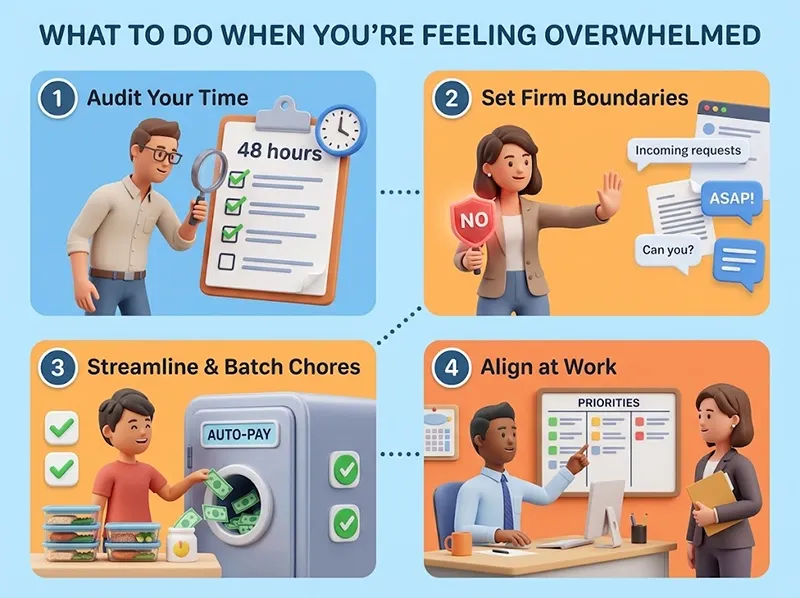
When chronic friction spreads across your career, household chores, and personal obligations, band-aid fixes fall short. If you find yourself consistently feeling overwhelmed with life, the issue is rarely a shortage of hours. The real culprit is an unexamined operational structure that allows trivial tasks to erode your capacity.
Identify What's Taking Up Most of Your Time and Energy
You cannot solve a bottleneck you have never measured. When you are overwhelmed with life, run a simple 48-hour operational audit: note every task, meeting, and administrative distraction on an index card.
You will likely discover that silent leaks—such as endless messaging threads and unbatched errands—consume hours of productive focus. Tracking this reality reveals exactly how to reduce mental load without guessing.
Set Boundaries Around Your Time and Commitments
Taking on too much usually stems from default compliance rather than deliberate intention. In Essentialism, Greg McKeown writes, "If you don't prioritize your life, someone else will." Saying yes to low-value obligations inevitably means saying no to your own clarity.
To learn how to stop taking on too much, you must practice how to say no to commitments that generate low return. Treat white space on your calendar as an essential operational buffer, not empty real estate waiting to be filled.
Make Everyday Responsibilities Easier to Manage
Rethink how you handle domestic chores and recurring administrative tasks. Instead of tackling issues spontaneously as they surface, standardize routine obligations into predictable batches.
Task Category | High-Friction Ad-Hoc Handling | Streamlined System |
Household Admin | Paying bills manually whenever alerts ping | Automated recurring payments |
Weekly Meals | Deciding dinner nightly from scratch | Fixed weekly meal rotation & grocery list |
Routine Inquiries | Drafting unique email replies repeatedly | Reusable communication snippets & templates |
Standardization shows you how to simplify daily life and how to manage daily responsibilities with minimal resistance.
What to Do When You're Overwhelmed at Work
Workplace paralysis often peaks when managers treat every incoming request as top priority. If you are feeling overwhelmed at work, avoid suffering in silence or working excessive overtime.
Maintain a visible, ranked task queue to manage being overwhelmed at work. When leadership drops an urgent assignment onto your desk, present the queue directly: "I can complete this immediately. Which of these three current deliverables should we pause or push back?" This tactic transforms hidden stress into objective trade-offs.
How to Keep Feeling Overwhelmed From Becoming a Daily Pattern
Without an ongoing maintenance routine, operational friction inevitably returns. If you constantly feel stuck, prevent feeling overwhelmed all the time by shifting from emergency triage to steady structural habits. Designing reliable checkpoints safeguards your mental clarity before chaos begins to snowball.
Build a Simple Daily Reset Routine
An unreviewed day leaves mental threads hanging overnight, sabotaging rest and focus. Dedicate the final ten minutes of your workday to a structured shutdown routine: log open tasks, park incomplete items onto tomorrow's list, and shut down open workspace tabs.
Establishing this brief ritual masterfully demonstrates how to manage daily responsibilities. Clearing open loops before stepping away lets your brain disengage, ensuring tomorrow begins with clear direction instead of morning hesitation.
Leave Room for Unexpected Tasks and Rest
Packing every hour with meetings and tasks creates immediate system failure when routine disruptions occur. Learn how to avoid being overwhelmed by capping your calendar at 70% capacity.
Leaving the remaining 30% open acts as an essential operational buffer for incoming emergencies, delayed replies, and restorative pauses. This deliberate breathing room shows how to simplify daily life and how to make life less stressful over the long run.
Conclusion
Regaining personal agency is not about emptying an infinite inbox or completing every conceivable task; it is about building reliable boundaries that protect your focus. When feeling overwhelmed, you do not need sweeping transformations—only grounded triage and clear operational pauses. By moving tasks outside your head, picking a single next step, and rejecting low-value noise, you reclaim control. Sustainable momentum comes from repeatable, practical steps applied consistently, turning daily friction into steady, dependable progress.
Was this article helpful?
Next Article
Inspirational Quotes About Life and Struggles: Best Quotes to Stay Strong
Comments(1)
Feeling overwhelmed is the worst. I found that managing my ADHD is much easier when I use Taskai on my Android to capture every brain dump as a reminder. It really helps bridge the gap between planning and doing.