
Let’s consider a typical hectic day from our own experiences. There are times when I finished a grueling day feeling completely drained and frustrated, convinced that nothing meaningful was actually achieved, despite having exerted massive effort. In reality, this perpetual complexity is not a personal failure; it is a structural design flaw in how we build our daily operating systems. We live in an era where an unceasing barrage of information, micro-decisions, and responsibilities constantly bombards us, steadily eroding our cognitive bandwidth and depleting our core energy.
Modern life subjects us to an unprecedented velocity of digital noise and obligations. As Greg McKeown outlines in Essentialism, if you do not prioritize your own schedule and commitments, someone else will gladly do it for you. Navigating this environment requires stepping back from the trap of doing more and learning how to simplify your life through deliberate, high-leverage boundaries. Whether you are searching for actionable simple life tips or a robust framework for simple living, the objective is to eliminate non-essentials and regain mental clarity.
If you prefer a visual or auditory format over reading, you can watch our breakdown video below before diving into the core strategies. To help you navigate this guide efficiently, use the jump-to links below to find the specific systems that fit your workflow.
Why Complexity Creeps In: The Roots of Overwhelm
Complexity never invades our lives overnight. Instead, it accumulates layer by layer, acting like an imperceptible sediment that slowly builds up over time. In my own observations across numerous projects, I realized that we rarely fall into a state of chronic overwhelm because of one massive, catastrophic decision. Rather, we sink into a vortex of busyness through hundreds of unexamined small yesses and unvetted commitments that quietly drain our cognitive reserves.
Modern cognitive overload largely stems from unchecked digital inputs and infinite options. Cal Newport highlights in Digital Minimalism that humans are simply not wired to be constantly wired, yet we routinely subject our brains to an unending stream of notifications, feeds, and open loops. When every digital distraction shatters our focus into fragments, trying to figure out how to simplify your life becomes an absolute necessity rather than a casual preference.
Identifying the Hidden Triggers That Derail How to Simplify Your Life
The hidden triggers of daily friction often hide in plain sight, disguised as productivity or modern necessity. Whether it is tracking tasks across multiple chaotic apps, juggling endless communication channels, or relying on a disorganized paper planner that holds every unstructured thought, our operational systems frequently work against us. Without a deliberate review mechanism, these subtle friction points multiply, resulting in constant mental fatigue and diminishing returns on our daily efforts.
To counteract this persistent drift toward complexity, we must adopt principles akin to Shunmyo Masuno's teachings in The Art of Simple Living, recognizing that an unburdened mind requires an intentional reduction of stimuli. When we examine our daily routines closely, we often find that the real bottleneck is not a lack of time, but an excess of poorly managed inputs. Stripping away these silent anchors allows us to reclaim our focus and build a sustainable rhythm.
Rethinking Daily Commitments to Live a More Simple Life
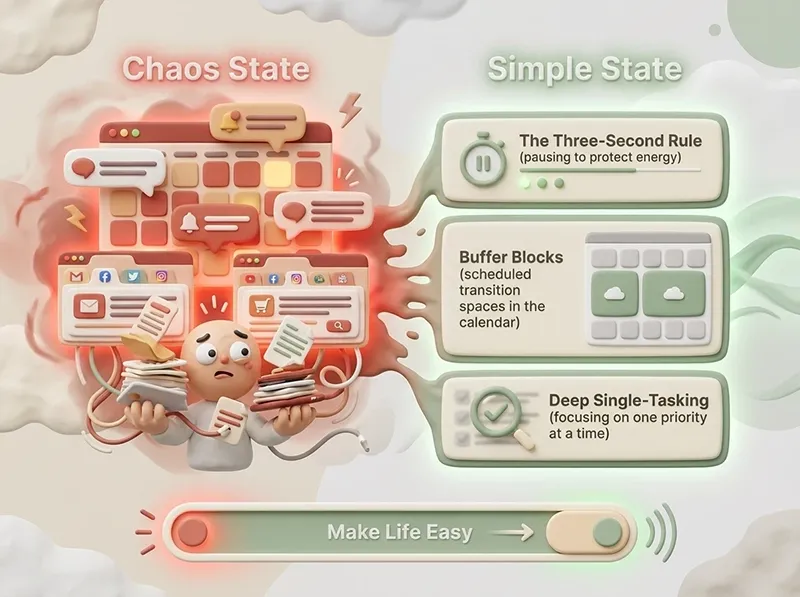
Complexity does not arrive through massive lifestyle upheavals; it sneaks in through unvetted commitments and reactive habits. If you want to live a more simple life, you must transition from reactive busyness to intentional architectural design. By restructuring how you say yes, managing your calendar buffers, and automating repetitive friction, you regain total command over your daily bandwidth.
The Power of Saying No to Protect Your Energy
Every automated “yes” to an external request acts as an unconscious rejection of your core priorities. When responsibilities overlap and consume your attention, setting strict operational boundaries becomes non-negotiable. Trying to master how to stay organized requires defending your calendar with absolute clarity. Adopting this defensive posture protects your mental bandwidth from constant fragmentation and preserves your deep energy for what genuinely moves the needle.
Try utilizing the simple "three-second rule" before answering any incoming request. Pause for three brief seconds and evaluate whether the proposed commitment builds your energy or burns it down. If it drains your core reserves, deploy a pre-scripted, polite decline without hesitation. Saying no is never an act of hostile rejection; instead, it serves as an active, disciplined defense of your personal space and long-term focus.
Streamlining Schedules to Make Life Easy and Manageable
Your daily calendar functions as the physical mirror of your internal cognitive state. If your schedule consists of back-to-back meetings with zero transition space, your mind remains trapped in a perpetual state of defensive panic. To make life easy and sustainable, adopt Leo Babauta’s focus methodologies by selecting only three primary priorities each day rather than maintaining an unmanageable ten-item checklist. Build mandatory fifteen-minute buffer blocks between sessions, and ruthlessly commit to deep single-tasking over chaotic multi-tasking.
Streamlined Single-Tasking (The Simple Path) | Chaotic Multi-Tasking (The Complex Path) |
Deep, unbroken focus blocks | Scattered tabs and fragmented attention |
Intentional, respectful boundary-setting | Automatic, guilt-driven compliance |
Calendars featuring built-in buffer recovery time | Ruthlessly packed, breathless schedules |
Delegating or automating repetitive operational tasks | Manual execution of every trivial chore |
Pre-determined, simplified daily choices | Reactive, split-second decision fatigue |
Automating and Delegating Routine Tasks
Manual friction kills momentum. To establish lasting simple lifestyle tips and sustainable routines, you must systematically offload repetitive operational loops. Implementing a robust four-step framework transforms chaotic manual chores into streamlined automated systems, freeing your cognitive bandwidth for creative problem-solving and strategic execution:
- Identify Bottlenecks: Scan your weekly operations to pinpoint recurring manual tasks, administrative overhead, and repetitive communication loops that consume disproportionate amounts of time.
- Document Processes: Record clear, step-by-step Standard Operating Procedures (SOPs) or reusable templates so that every routine procedure follows a standardized, predictable path.
- Train Systems or Assistants: Configure automation software, scripts, or delegation partners to handle the execution phase independently without requiring your constant microscopic supervision.
- Release Mental Burden: Completely excise the task from your active working memory, trusting your newly engineered system to manage the routine execution reliably in the background.
Designing a Sustainable Simple Lifestyle for Long-Term Clarity
Physical and digital environments directly shape our internal cognitive states. When our desks overflow with paperwork and our desktop displays feature hundreds of stray files, our brains process this visual clutter as a continuous stream of background interruptions. Transitioning toward a genuine simple lifestyle requires us to deliberately engineer our surroundings. By curating what we allow into our physical and virtual spaces, we dramatically reduce decision fatigue and create an environment that naturally supports calm, focused execution.
Decluttering Physical and Digital Spaces to Simplify Your Life
Environmental optimization begins by eliminating excess possessions and digital noise. As Fumio Sasaki demonstrates in Goodbye, Things, the physical objects we own demand ongoing maintenance, consuming precious mental real estate long after their utility has expired. To truly simplify your life, you must apply systematic decluttering rules, such as hiding ambiguous items for thirty days or executing a digital zero-inbox policy. When you remove visual noise from your immediate surroundings, your mind instantly gains the spaciousness required for high-level strategic thinking without relying on temporary fixes.
Intentional Consumption and Mindful Spending
Modern consumer culture constantly pushes us to buy solutions to problems created by buying in the first place. Embracing the art of simple living means breaking this reactive cycle through mindful consumption. Before acquiring any new possession, pause to evaluate whether it genuinely serves your long-term values or merely provides a temporary dopamine spike. Adopting strict purchasing boundaries protects your financial health and prevents clutter from creeping back into your freshly optimized spaces.
Practical Frameworks: How Do You Simplify Your Life Every Single Day?
Transitioning from high-level theoretical concepts down to actionable daily execution requires shifting your focus from massive lifestyle overhauls to sustainable micro-habits. Asking how do you simplify your life is not about finding a single permanent fix, but rather about establishing dependable daily systems that absorb friction before it turns into cognitive overload. By breaking macro-strategies into microscopic, repeatable actions, you lay the groundwork required to secure a simpler life without experiencing burnout.
Building Micro-Habits to Successfully Simplify Your Life
Lasting organizational momentum relies on tiny, friction-free adjustments executed consistently over time. Instead of attempting a radical twenty-item overhaul, anchor one small habit into your existing routine—such as clearing your digital desktop for two minutes each evening or drafting a strict three-item priority list before logging off.
Successfully executing these micro-steps compounds quietly in the background, gradually rewriting your operational defaults. When your daily actions require zero internal negotiation, maintaining clarity becomes an automatic state rather than a constant struggle, making it effortless to simplify your life without emotional resistance.
Conclusion
Simplifying your daily existence is not a temporary weekend project or an absolute destination you check off a list. As Shunmyo Masuno wisely observes in The Art of Simple Living, the true quality of each day is determined not by external chaos, but by the quiet clarity of your own mind. By continuously stripping away non-essential friction, you protect your core energy and make intentional room for genuine rest, focus, and meaningful personal priorities.
True systemic transformation happens when you commit to sustainable, long-term momentum rather than exhausting, radical overhauls. As you embrace the principles of living a simple life and a year of living simply, remember that every small boundary you set creates a powerful ripple effect. Stay patient with your progress, honor your right to rest, and let your daily choices reflect the core philosophy of Organize Life. Simply.
Was this article helpful?
Next Article
Best AI Personal Assistant Tools for Everyday Tasks: Daily Planner Apps Worth Trying
Comments(0)
Be the first to leave a comment.