

I have watched many retirees struggle with the financial uncertainty of their post-career years. Retirement planning can easily feel overwhelming and exhausting, especially when trying to balance immediate expenses with long-term security. If you find yourself asking what is a 401(k) and how it fits into your roadmap, learning the fundamentals is only half the battle. The core dilemma every earner faces is practical: how much should I contribute to my 401(k) without suffocating today's budget?
In field practice, the baseline answer is direct: capture your full employer match first, then work toward a total savings rate of 10% to 15% of your pre-tax income. However, the right amount for your 401(k) contribution depends on your take-home pay, non-negotiable living costs, and investment horizon. Setting your 401(k) contribution percentage is a cash-flow decision, not an all-or-nothing test.
What Is a 401(k) and How Does It Work?
Understanding what is a 401k and how does it work starts with a simple idea: a 401(k) is an employer-sponsored retirement account that allows you to invest part of your paycheck for the future. Your contributions are generally deducted automatically from your salary and invested in options available through your employer's plan. Unlike a traditional savings account, a 401(k) does not offer a guaranteed return. Its value can rise or fall depending on investment performance.
A 401(k) can make retirement saving more consistent by helping you contribute regularly throughout your working years. The amount you save, your investment choices, any employer matching contributions, and the time your money remains invested can all affect your eventual retirement balance.
What Is a 401(k) Plan?
To understand what is a 401k plan, think of it as a workplace retirement savings program. You choose how much of your eligible pay to contribute, and your employer deducts that amount from your paycheck. You can then select from the investment options offered by the plan, depending on its rules.
Key 401k benefits may include tax advantages, automatic payroll contributions, and employer matching contributions. If your employer matches part of what you contribute, you may receive additional money toward retirement, subject to the plan's matching formula and vesting rules. Over time, your contributions and any investment returns can build your retirement savings, although investment gains are never guaranteed.
What Is the Difference Between a Traditional and Roth 401(k)?
The main difference between a traditional and a Roth 401(k) is when you pay income tax on your contributions and withdrawals.
When considering what is a Roth 401k, the key point is that Roth contributions are made with after-tax dollars. Qualified withdrawals in retirement, including eligible investment earnings, are generally tax-free. With a traditional 401(k), contributions are generally made before federal income tax, which can reduce your current taxable income. Withdrawals are generally taxed as ordinary income in retirement.
Your choice depends on factors such as your current tax situation, your expected tax rate in retirement, and the options available through your employer's plan. Neither option is automatically better for everyone.
Account Type | Tax Timing | Growth | Withdrawals in Retirement |
Traditional 401(k) | Pre-tax dollars (reduces today's taxes) | Tax-deferred | Taxed as ordinary income |
Roth 401(k) | After-tax dollars (no immediate tax break) | Tax-free | 100% Tax-free (qualified distributions) |
How Much Should I Contribute to My 401(k)?
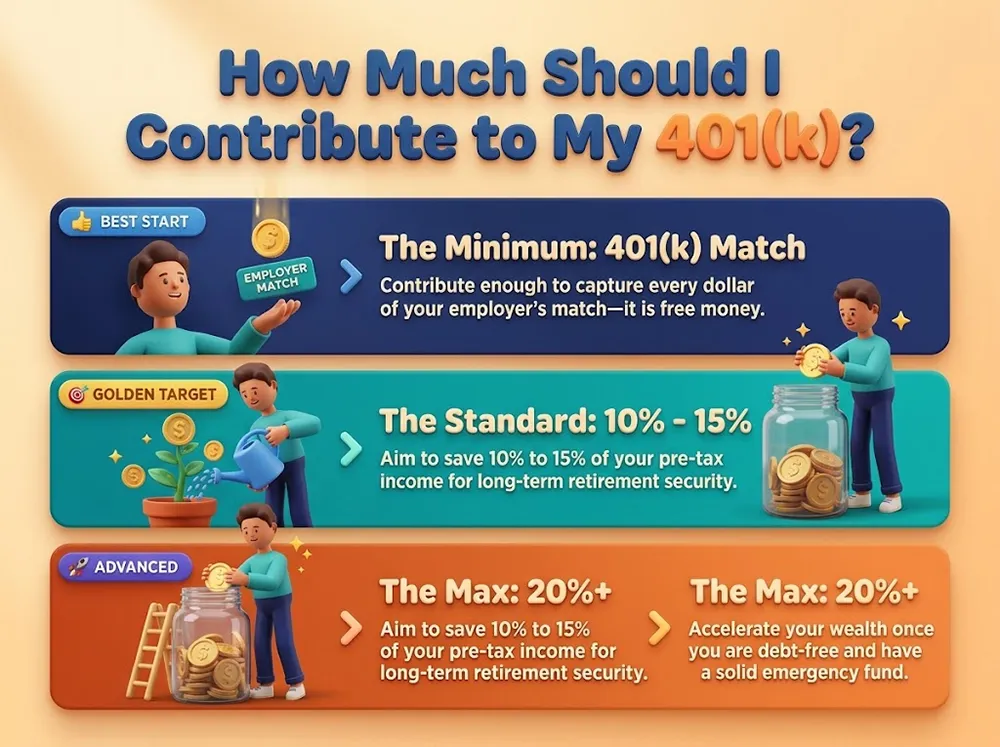
Deciding how much should I contribute to my 401k depends directly on your fixed living expenses, outstanding debts, and overall cash flow. There is no standard percentage that works equally for every household. Setting this contribution rate is simply one part of your broader financial planning steps, where retirement savings must be balanced against everyday rent, utilities, and debt obligations.
Is 10% to 15% a Good 401(k) Contribution Goal?
A frequent guideline cited by financial firms such as Fidelity and Vanguard suggests targeting total retirement savings between 10% and 15% of annual gross income. In most models, this total includes both your personal payroll deduction and any employer match.
This benchmark stems from retirement planning studies estimating that retirees typically require roughly 55% to 80% of their working income to cover living expenses, assuming Social Security provides a portion of that total. When determining how much should you contribute to 401k plans, remember that 15% is an aggregate benchmark for long-term modeling, not a mandatory starting requirement for someone with immediate financial pressures.
What Percentage of Your Paycheck Should Go Into a 401(k)?
When figuring out what percent should I put in my 401k per paycheck, start with what your actual take-home pay permits.
Many workers ask: is 6% a good amount to contribute to a 401k? If your company matches contributions up to 6%, setting your rate at 6% allows you to collect that full match. If your employer only matches up to 3% or offers no match at all, 6% is simply an affordable entry point that leaves room for other living costs.
Conversely, is 20% contribution to a 401k too much? A 20% contribution rate can work well for earners who have already eliminated credit card debt, established an emergency fund, or need to accelerate savings later in their careers. It becomes a problem only if it leaves you short on liquid cash for unplanned expenses or basic bills.
Practical Check: Two-Paycheck Verification
Check your net take-home pay on your paystubs for two consecutive pay cycles after changing your 401(k) contribution percentage. Confirm that your bank balance covers all core monthly bills without needing short-term credit.
How Much Should I Contribute to My 401(k) If I Make $60,000?
Evaluating how much should I contribute to my 401k if I make 60k becomes clearer when looking at actual pay-period deductions. For a gross salary of $60,000 paid bi-weekly across 26 paychecks, the numbers break down as follows:
Contribution Rate | Annual Deduction | Monthly Average | Per Paycheck (Bi-Weekly) |
6% | $3,600 | $300 | $138.46 |
10% | $6,000 | $500 | $230.77 |
15% | $9,000 | $750 | $346.15 |
Note: These amounts reflect gross pre-tax deductions. They do not account for plan administration fees, investment performance, or state and federal tax withholdings.
If putting aside $346.15 every two weeks tightens your cash flow too much, choosing a lower rate like 6% ($138.46) keeps you participating in the plan without disrupting your monthly bills.
How Should You Decide on Your 401(k) Contribution?
Deciding your final contribution rate requires ordering your financial priorities in a sequence that protects current solvency while funding the future. Throwing extra money into retirement accounts while ignoring short-term cash pressures usually leads to withdrawing funds early under penalizing conditions. Looking at your total balance sheet—including interest rates on existing obligations—shows where each dollar does the most functional work.
Should You Contribute Enough to Get the Full Employer Match?
Securing your full 401k employer match is almost always the first logical step. In I Will Teach You to Be Rich, author Ramit Sethi notes that an employer match represents an immediate return on your investment that no market index can promise on day one.
Formulas vary by employer. A standard arrangement is a 50% match on the first 6% of compensation, while another common model is a 100% match on the first 3% plus 50% on the next 2%. Readers frequently ask: is a 5% 401k match good? A 5% match is competitive and provides significant supplemental funding. Running an online 401k calculator with match illustrates how these company dollars change your total annual additions.
Keep vesting schedules in mind. If your plan requires three years of service before employer contributions fully vest, leaving the job before that timeline means forfeiting unvested employer funds.
Should You Max Out Your 401(k) or Balance Other Financial Goals?
When considering should i max out my 401k, evaluate your non-retirement accounts first. The established Bogleheads investment priority ladder outlines a methodical approach:
- Contribute enough to capture the full employer match.
- Pay off toxic, high-interest consumer debt (such as credit cards).
- Build a cash reserve covering three to six months of bare-bones living expenses.
- Increase your 401k contribution or fund an individual retirement account (IRA).
Strategy | Allocation Example | Practical Outcome |
Flawed Priority | Maxing 401(k) at 20% while carrying $8,000 at 24% credit card APR | Guaranteed negative net worth drag; interest costs outpace expected portfolio returns. |
Balanced Priority | Contributing to get the match, putting excess cash toward 24% debt | Eliminates expensive interest drag while capturing the company contribution. |
What Are the 2026 401(k) Contribution Limits?

Every year, the federal government adjusts elective deferral caps to account for cost-of-living changes. Understanding these official 401k contribution limits is an essential technical element of realistic personal financial planning, as exceeding these boundaries can trigger tax penalties and require corrective distributions.
How Much Can You Contribute to a 401(k) Per Year?
Under official guidance from IRS Notice 2025-67, knowing how much can I contribute to my 401k in 2026 starts with the base employee deferral. For workers under age 50, the maximum elective contribution is $24,500. This ceiling applies to your total employee contributions across traditional and Roth options combined.
For savers aged 50 and older, standard catch-up provisions allow an additional $8,000, bringing the effective individual ceiling to $32,500. Furthermore, under provisions established by the SECURE 2.0 Act, individuals who turn ages 60, 61, 62, or 63 qualify for a higher "super catch-up" limit of $11,250, provided their specific employer plan supports it.
High earners should also account for statutory tax-classification changes: under SECURE 2.0 rules, employees whose prior-year FICA compensation exceeded $145,000 (indexed to $150,000 for recent plan calculations) must designate all catch-up contributions as after-tax Roth deposits.
When evaluating how much can you put in a 401k per year, keep in mind that this employee cap does not include employer matching funds. The combined limit for both employee deferrals and employer additions reaches $72,000, setting the absolute max 401k contribution available from all funding sources.
How Can You Adjust Your 401(k) Contributions Over Time?
Your contribution rate should not stay fixed across your entire career. As living expenses shift, debts get cleared, or base pay increases, scheduled annual adjustments keep your retirement targets aligned with your changing financial reality without forcing abrupt spending cuts.
When Should You Increase or Reassess Your Contribution?
A practical method to raise your contribution is through auto-escalation, a plan feature that automatically increases your payroll deduction by 1% each year, often timed with annual salary reviews. Directing a small slice of a raise straight into your 401(k) contribution prevents lifestyle creep—the tendency for discretionary spending to expand alongside income.
Workers tracking their progress often ask: how much should I have in my 401k at specific career stages? Common retirement planning models suggest holding one times your annual salary by age 30, three times by age 40, and six times by age 50. Treat these benchmarks as diagnostic check-ins rather than rigid tests.
Career transitions also demand an account audit. When asking what happens to 401k when you quit, your invested balance remains yours, but you cannot make new payroll contributions. Knowing what to do with old 401k accounts comes down to three main choices: leave the balance in place if your former employer allows it, transfer the funds to your new employer’s 401(k), or execute a direct rollover into an IRA. For official regulatory rules on safeguarding rollovers and handling legacy workplace plans, consult the U.S. Department of Labor EBSA Retirement Guide.
Frequently Asked Questions About 401(k) Contributions
How much should I contribute to my 401(k) if my budget is extremely tight?
When money is tight, prioritize contributing just enough to capture your full employer match. If your employer offers no match, start with an affordable amount—such as 1% to 2% of your paycheck—or pause contributions temporarily until high-interest debt is eliminated and basic living costs are stabilized.
Is contributing 20% to a 401(k) ever a mistake?
Yes. While a 20% rate accelerates retirement savings, it becomes a mistake if it forces you to carry high-interest credit card debt, leaves you without liquid emergency reserves, or causes you to exceed annual IRS contribution ceilings.
What is the smartest thing to do with an old 401(k) after quitting?
For most workers, the most practical move is a direct rollover into an IRA or into their new employer's 401(k) plan. Direct transfers preserve tax deferral, avoid early withdrawal penalties, and frequently lower administrative investment fees compared to leaving fragmented accounts behind.
Conclusion
Determining an effective retirement savings plan is not about chasing arbitrary figures; it is about establishing a savings rate that fits your monthly cash flow. Setting an overly ambitious target that forces you to rely on credit cards creates financial stress rather than security.
To decide how much should I contribute to my 401k with confidence, follow this simple framework:
- Capture the full company match: Treat your employer's matching formula as non-negotiable compensation.
- Protect baseline cash flow: Keep your 401(k) contribution percentage at a level that lets you pay rent, service essential obligations, and maintain a modest cash buffer.
- Turn on auto-escalation: Schedule a 1% annual increase each time your base compensation adjusts.
- Audit your accounts annually: Revisit your total 401(k) contribution every year to stay aligned with updated IRS limits and changing household priorities.
Sustainable financial progress comes from consistency. Choose a contribution rate you can maintain through normal economic fluctuations, and let regular compounding do the heavy lifting over time.
Was this article helpful?
Comments(0)
Be the first to leave a comment.