

Do you remember building that vibrant, color-coded spreadsheet to track every single dollar? Or worse, are you still clinging to it every weekend? Traditional manual systems for personal financial planning are fundamentally designed to fail. Expecting an exhausted brain—drained after eight hours of deep analytical work or coding—to sit down late at night and manually log coffee receipts and recurring app subscriptions is an absurd fight against basic human biology.
Having stress-tested multi-tool setups across fractured accounts for years, I watched my own hyper-organized spreadsheets break down the moment workload surged. As David Bach sharply observed in The Automatic Millionaire, relying on discipline and memory guarantees eventual burnout. Real financial control is not an endurance test of willpower. It requires removing daily friction entirely through modern automation, turning chaotic ledgers into a reliable, self-driving wealth infrastructure.
What Is Personal Financial Planning in the Automated Age?
Logging where your cash went last week is not financial planning—it is an autopsy. In traditional workflows, you act as an exhausted archivist cataloging past mistakes instead of engineering future liquidity. Modern personal financial planning flips this dynamic entirely. Instead of looking backward through manual ledgers, algorithmic systems establish proactive rules that direct cash flow automatically before impulse spending strikes.
What Are the 5 Basics of Personal Finance That Automation Solves?
Every conventional money framework hinges on five pillars, which also happen to be the exact operational choke points where procrastination, human error, and decision fatigue destroy consistency:
- Income Routing: The second a paycheck lands, automated protocols divide capital instantly across designated sub-accounts, eliminating idle cash temptations.
- Spending & Guardrails: Contemporary personal finance tools categorize merchant transactions in real time, serving as active bumpers rather than passive post-mortems.
- Frictionless Saving: Instead of saving whatever scrap is left over at month's end, automated round-ups and scheduled day-one transfers turn cash accumulation into an invisible habit.
- Automated Investing: Setting recurring dollar-cost averaging into index funds removes emotional bias and endless market-timing stress from wealth accumulation.
- Debt Payoff Pipelines: Auto-pay workflows systematically execute principal repayments to preserve credit health, permanently eliminating missed-payment penalties.
Can I Do Financial Planning Myself Without Getting Overwhelmed?
Yes, but only if you abandon the idea that self-direction requires manual bookkeeping. When clients ask about DIY systems, my response centers on operational friction. Running manual balance sheets turns your weekend into an unpaid accounting shift.
By offloading transactional data harvesting to secure financial planning tools, you reclaim four to five hours every single month. Understanding what does a financial planner do clarifies this distinction: their true value is high-level asset strategy, not transaction bookkeeping that code executes better.
Personal Financial Planning Frameworks: Adapting the 50/30/20 Rule Digitally
Elizabeth Warren’s classic 50/30/20 framework often collapses when tracked through static envelopes or spreadsheets. Digital automation turns this mental model into a self-executing engine. Direct-deposit splits immediately shunt 20% into investments, 50% into a dedicated bills account, and leave 30% for guilt-free lifestyle spending.
As Ramit Sethi reinforces in I Will Teach You to Be Rich, constructing an automated pipeline allows you to spend guilt-free because your baseline responsibilities are already satisfied behind the scenes. This structured separation transforms affordable financial planning from an abstract ideal into a daily operational reality.
The Engine: Financial Planning Software vs. Fragmented Spreadsheets
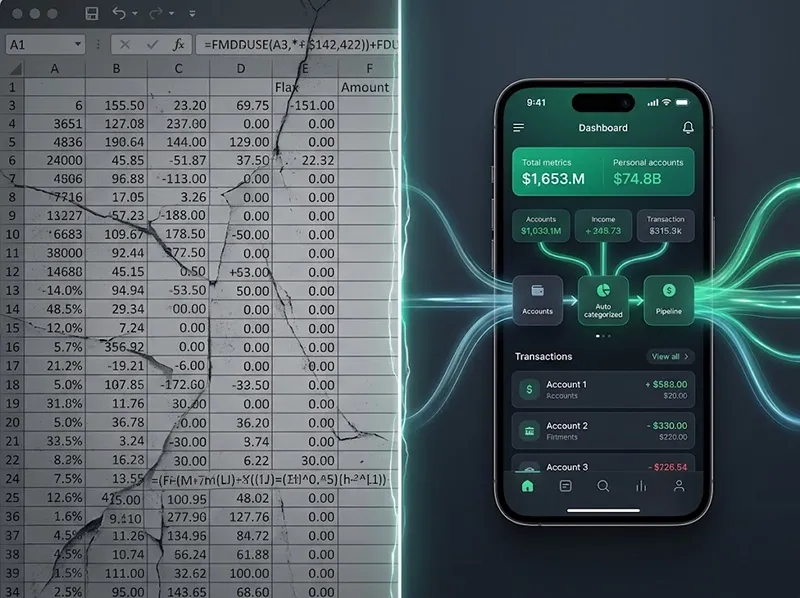
Relying on disconnected spreadsheets creates brittle data silos that break whenever an institution updates its export format. Moving to dedicated financial planning software elevates you from an entry-level clerk to an architect of a resilient balance sheet. Instead of patching broken formulas, you operate a unified command center that streams institutional data directly into clear capital allocations.
Ramit Sethi offers a golden rule in I Will Teach You to Be Rich: “The single most important factor in whether or not your money grows is not how much you earn, but how automated your system is. Spend your willpower on building the machine once, then let it run.” We are not trying to turn you into an accountant; we are designing a self-driving machine that optimizes wealth silently in the background.
Best Financial Planning Software for Net Worth Tracking & Long-Term Projections
Selecting the best financial planning software requires choosing between localized legacy power and nimble cloud sync. Tools like Quicken Personal Finance still deliver granular transaction controls and offline data sovereignty for power users who demand detailed category hierarchies.
Modern web-first platforms counter this with real-time net-worth aggregations that update without manual entry. Integrating holistic budgeting and planning software eliminates tracking blind spots across checking accounts, brokerage holdings, and illiquid physical real estate.
Advanced Scenarios: Retirement Planning Software and Multi-Asset Portfolios
Static formulas cannot accurately model sequence-of-returns risk or dynamic tax brackets across retirement distributions. Dedicated retirement planning software integrates Monte Carlo simulations that stress-test portfolio longevity against historical inflation spikes and bear markets.
Institutional-grade tools like MoneyGuidePro set the standard for financial advisors calculating the capital requirements of a 65-year-old couple facing medical inflation. In The Psychology of Money, Morgan Housel notes that financial success is primarily about managing behavior rather than maximizing raw math. Advanced software removes psychological panic by showing you probability bands instead of arbitrary static balances.
Cloud Based Financial Planning Software: Security, Latency, and Bank-Sync Reliability
The biggest friction point in cloud based financial planning software has always been API connection stability. Modern tools rely on encrypted aggregators like Plaid, MX, or Finicity, which use tokenized, read-only connections.
These enterprise security layers ensure the software never stores your raw bank login credentials or holds transaction withdrawal authority. While occasional API disconnects require manual re-authentication, the security and continuous aggregation trade-offs beat handling unencrypted, vulnerable spreadsheets on your hard drive.
Tactical Execution: Best Financial Planning Apps for Everyday Cash Flow
Desktop software sets your macro direction, but your daily habits happen on your phone while waiting in line for groceries. That mobile interface is where theoretical financial targets collide with impulsive reality. Deploying the best financial planning apps turns that pocket friction into automated behavioral guardrails.
During my own transition away from manual tracking, shifting to mobile-first workflows was what finally eliminated the constant mental calculation of "can I afford this today?" For anyone ready to turn those everyday habits into a structured plan, learning how to create a financial plan provides the foundation for making better financial decisions.
Best Personal Finance App Deployments for Zero-Based Allocation
Finding the best personal finance app comes down to whether an interface encourages active behavioral change or passive observation. Zero-based budgeting remains the gold standard here: every dollar that lands in your account receives a specific operational mission before you spend it.
As Jesse Mecham emphasizes in You Need A Budget (YNAB), assigning purposeful jobs to your money transforms a budget from an agonizing restriction into permission to spend without anxiety. When I tested modern zero-based apps paired with live bank feeds, cash leaks shrank instantly because unassigned capital simply did not exist.
Using an agile personal finance manager keeps envelopes updated automatically. Instead of reconciling transactions on Sunday nights, the app reallocates spending limits right at the cash register.
Best App to Budget Money and Eradicate Hidden Subscription Creep
Unchecked micro-transactions are the silent killers of compounding growth. Sifting through months of bank statements to flag five forgotten streaming tiers is exhausting, making automated detection a necessity. The best app to budget money deploys intelligent background algorithms to identify recurring merchant charges and surface forgotten subscriptions before renewal.
Pairing an automated personal finance tracker with active leak detection immediately reclaimed over $140 per month in my own accounts—mostly legacy SaaS trials and redundant cloud storage. Modern apps don't just alert you to these recurring charges; many now offer built-in, one-click cancellation services.
How to Integrate a Budget Money App into a Daily Minimalist Routine
The goal of implementing a budget money app is not to replace phone addiction with obsessive net-worth checking. Opening a dashboard eight times a day is merely performative productivity. A truly effective system works passively in the background, surfacing only when a baseline boundary is breached.
Configure your personal finance management app to send push notifications exclusively for anomalous transactions, annual bill renewals, or when an envelope category crosses 80% of its allocation limit. This single operational shift decouples everyday peace of mind from chronic screen time.
Direct Execution Matrix: Static Ledger Tracking vs. Dynamic Engine Sync
Evaluation Metric | Static Ledger Tracking (Spreadsheets) | Dynamic Engine Sync (Automated Apps) |
Data Collection | 👎 Manual export, file cleanup, and CSV uploads | 👍 Automated 24/7 bank synchronization |
Behavioral Impact | 👎 Backward-looking autopsy of past mistakes | 👍 Real-time category guardrails before purchase |
Hidden Leak Detection | 👎 Requires painstaking line-by-line audits | 👍 Proactive algorithmic subscription detection |
System Resilience | 👎 Breaks when workload spikes or formulas fail | 👍 Runs independently without human willpower |
System Architecture: Step-by-Step Personal Financial Planning Automation

A collection of apps without a unified pipeline is just digital clutter. To make automation work, you must connect your accounts into a sequential routing circuit where capital flows without manual input. Treating your balance sheet like an automated assembly line eliminates the emotional hesitation that usually stalls savings.
As James Clear famously writes in Atomic Habits, "You do not rise to the level of your goals. You fall to the level of your systems." Structuring your personal financial planning around an automated infrastructure ensures your long-term wealth strategy executes flawlessly, regardless of how chaotic your workweek gets.
What Are the 5 Basic Steps in Personal Financial Planning Pipelines?
Building a resilient financial machine requires an orderly sequence. Modern personal financial planning tools make it possible to run this entire five-step pipeline in the background:
- Capture: Aggregate every liquidity node—checking, payroll, brokerage, and debt facilities—into a single read-only engine to maintain zero visibility blind spots.
- Categorize: Deploy auto-tagging algorithms that parse transactions instantly, filtering ongoing living overhead from discretionary lifestyle spend.
- Reserve: Split baseline emergency funds and tax allocations into automated, high-yield holding vaults the moment fresh capital lands.
- Deploy: Schedule autonomous recurring transfers that fund diversified investment portfolios, executing consistent dollar-cost averaging without emotional timing.
- Rebalance: Use portfolio tracking software to audit asset weightings quarterly, restoring target allocations with minimal tax drag.
Common Mistakes to Avoid in Personal Financial Planning and Tool Selection
The most common failure point I observe among ambitious professionals is "over-tooling." Installing four overlapping apps simultaneously produces conflicting transaction alerts and extreme notification fatigue. When an API token inevitably expires, managing multiple platforms feels overwhelming, leading users to abandon the entire framework.
Relying too heavily on brittle manual spreadsheets creates another structural failure point. If your chosen financial planning tools require weekly CSV exports and manual formatting adjustments, the setup cost will eventually overcome your consistency. Choose minimal, resilient platforms with reliable bank connectivity instead of fragile, complex configurations.
Scaling Up: How to Make a Financial Plan for a Business and Solo Enterprises
Solopreneurs and small business operators face an additional layer of friction: commingled cash flow. Trying to run personal automation while paying company operating expenses out of the same checking account destroys category visibility and leads to severe tax compliance issues.
When learning how to make a financial plan for a business, the first step is building a strict firewall between enterprise and personal capital. Direct client revenue into an operational merchant account, automate your tax reserves, and pay yourself a consistent, fixed monthly salary transfer. This setup lets your automated personal pipeline run predictably without absorbing business volatility.
Algorithmic Governance: Software Automation vs. Certified Financial Planner
Some believe downloading a sleek financial app solves their entire balance sheet overnight—treating wealth like setting up a smart home, where you plug in a hub and expect the living room to run itself. But money is far messier than programming smart thermostats. Software excels at repetitive grunt work; tell an algorithm to route rent on the first of the month, and it executes without blinking.
Yet code lacks legal instincts and strategic nuance. Real personal financial planning requires knowing exactly where automated rules deliver leverage, and where blindly following code exposes you to regulatory, generational, or structural tax traps.
Certified Financial Planner Near Me: When Does Software Reach Its Limit?
Searching for a certified financial planner near me becomes essential the moment life outgrows deterministic if-then logic. Algorithms cannot negotiate delicate family estate battles, resolve cross-border entity structures, or resolve thorny inheritance disputes.
When your income branches into multi-state corporate entities or family trusts, software turns into a dumb calculator. An accredited fiduciary steps into that friction, translating subjective life goals into legal realities that no dashboard can synthesize on its own.
Deconstructing Financial Advisor Cost and Hybrid Advisory Models
Before rushing to find a financial advisor, you must dissect the fee structure. Traditional advisors typically charge an assets-under-management (AUM) fee of around 1% annually. On a $1,000,000 portfolio, you forfeit $10,000 every single year—even during brutal market downturns when your portfolio shrinks.
Advisory & Management Model | Annual Cost Breakdown (on $1M Portfolio) | Long-Term Capital Impact |
Traditional 1% AUM Advisor Model | $10,000 / year (Fixed percentage of total assets) | 👎 Severe compounding drag, billed even during market drops |
Hybrid SaaS + Fee-Only Planner | $1,700 / year ($200 software + $1,500 hourly consult) | 👍 High-level fiduciary oversight with minimal fee leakage |
Net Annual Retained Capital | +$8,300 saved per year | 🚀 Capital remains in your portfolio to compound over time |
That structural drag makes legacy advisors terrible for early-stage builders. High-profile endorsements like a Dave Ramsey financial advisor often route everyday retail investors into high-commission products with hefty upfront loads.
True affordable financial planning uses software to handle 90% of recurring execution, paired with an objective fee-only planner hired strictly on an hourly basis.
Conclusion
Sustainable wealth accumulation is never an endurance test of sheer willpower; it is an engineering challenge solved through structured systems. By linking intelligent financial planning software with agile mobile budgeting apps, you permanently eliminate manual friction, hidden subscription leaks, and decision fatigue. Modern personal financial planning does not demand that you become an unpaid bookkeeper for your own life. Construct your automated pipeline once, let algorithmic guardrails handle repetitive capital routing in the background, and reclaim your mental bandwidth for strategic growth.
Was this article helpful?
Next Article
NIST Artificial Intelligence Risk Management Framework: Complete NIST AI RMF Guide
Comments(0)
Be the first to leave a comment.