

Most people know they need a clear direction for their money, but the starting line often feels paralyzing. Where should you track income and expenses? Should you tackle credit cards first or hoard emergency cash? Early in my advisory work, I realized keeping numbers in your head creates constant, unnecessary anxiety. As Morgan Housel notes in The Psychology of Money, financial success is about repeatable behavior rather than raw intellect. Learning how to create a financial plan gives your daily choices structure.
A solid plan does not instantly boost your income. Instead, it diagnoses your real baseline, establishes measurable goals, and turns messy decisions into executable actions. In this guide, we break down how to create a financial plan using an end-to-end financial planning process. You will see exactly how to align cash flow, eliminate high-interest liabilities, and build resilient personal financial planning habits that fit real life.
How to Create a Financial Plan Step by Step
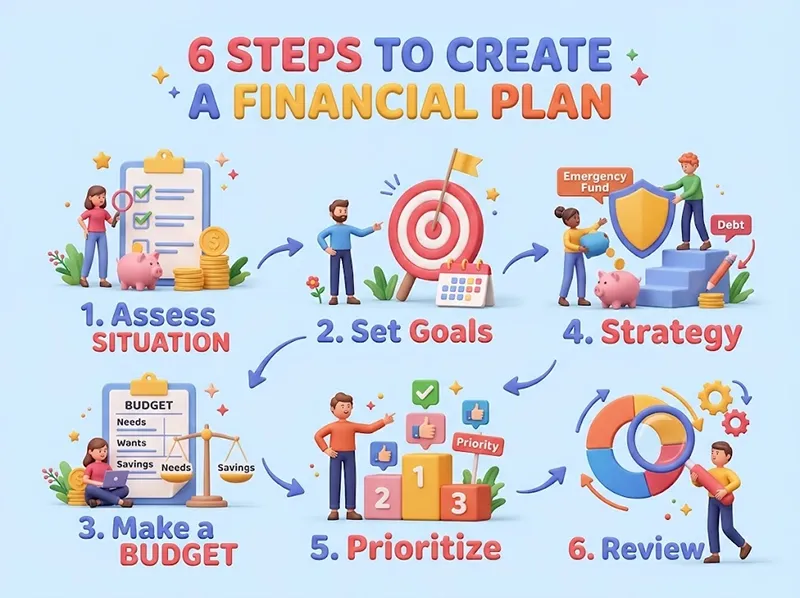
Building a financial roadmap becomes manageable when broken into clear operational stages. Rather than solving every money question at once, evaluate your current baseline, set intentional milestones, and construct realistic systems for daily cash flow, debt elimination, and savings. While academic texts cite five steps and the CFP Board standard defines seven, real-world execution relies on 6 steps in financial planning process discipline. This structured sequence ensures steady step by step financial planning momentum.
Following these practical steps to create financial plan clarity helps you move from basic awareness to confident choices. Here is exactly how to make a financial plan step by step using a sustainable financial planning process.
1. Assess Your Current Financial Situation
The starting point of building a workable plan is identifying where you stand today. Before setting arbitrary targets, you need an honest audit of your net cash flow, liabilities, and assets. As Dave Ramsey notes in The Total Money Makeover, taking control of money starts by facing your numbers directly.
Begin by listing total monthly net earnings alongside fixed commitments such as rent, mortgage installments, insurance, and utilities. Then, audit variable living expenses, transportation, subscriptions, credit balances, and investment accounts. This thorough financial assessment helps you systematically assess your financial situation and reveal operational leaks.
Taking inventory of your balances is the most reliable way to organize finances without cognitive strain. A clear snapshot of liabilities and liquid assets clarifies your personal financial situation and overall financial health, setting up realistic goal planning.
2. Set Clear and Measurable Financial Goals
Once your audit is complete, shift focus toward specific future milestones. Targets fail when left as vague wishes like "saving more." Effective financial goal planning requires an explicit dollar figure, a timeline, and a clear priority level for every objective. Without these parameters, daily spending quickly overrides long-term vision.
Structure your targets across distinct horizons: short term financial goals under twelve months (such as starter reserves), medium-term targets over one to five years, and long term financial goals like retirement readiness. By setting financial goals methodically, you translate broad ambitions into predictable monthly funding requirements.
3. Create a Budget That Supports Your Goals
A budget is simply the execution engine within a broader strategy, not the entire roadmap. Purposeful financial planning and budgeting ensures day-to-day spending actively fuels your primary milestones rather than draining cash unpredictably.
A practical framework for creating a personal budget is the 50/30/20 rule from All Your Worth: 50% for essentials, 30% for discretionary lifestyle wants, and 20% for savings and debt repayment. Dedicated tools like the Lifvero Budget Planner make categorizing cash flow straightforward.
Regardless of framework, your personal budget must stay flexible. Aligning your budget and financial plan keeps core commitments funded while steadily advancing savings and debt payoff each month.
4. Build a Savings, Debt, and Emergency Fund Strategy
A durable plan requires an explicit mechanism to protect cash while systematically dismantling high-interest obligations. Without a liquid safety net, any minor emergency quickly forces you into high-cost revolving debt, undoing months of disciplined cash management. Successful savings financial planning balances defensive cash reserves with offensive debt reduction, ensuring neither side of your balance sheet is neglected or compromised.
Start by locking in a foundational reserve of three to six months' worth of essential living expenses inside a high-yield liquid account. This dedicated emergency fund financial planning step shields your core investments from unexpected income interruptions or medical events. Simultaneously, build an aggressive debt repayment financial plan to eliminate non-mortgage liabilities, particularly predatory credit cards and high-rate personal loans that compound against your net worth.
When tackling balances, test established acceleration models. You might adopt the psychological momentum of the Dave Ramsey plan via the Debt Snowball (paying smallest balances first for behavioral wins), or implement the mathematically optimal Debt Avalanche (targeting the highest interest rates first). Combining structured liquidity with calculated debt elimination creates a resilient financial plan for saving money and protecting long-term growth.
5. Prioritize Your Financial Decisions
Having a list of targets often causes decision paralysis when cash flow feels constrained. Deciding what to fund first is where many well-intentioned plans collapse. Mastering your financial decisions requires an objective hierarchy: cover survival baselines first, secure an initial emergency cushion, wipe out toxic high-interest balances, capture employer retirement matches, and then channel surplus funds toward mid-term goals and independent wealth creation.
Priority Level | Strategic Action | Misguided Execution |
Tier 1: Survival | Cover core rent, utilities, and groceries | Upgrading discretionary tech subscriptions |
Tier 2: Safety | Fund a liquid starter emergency cash cushion | Buying volatile assets with no cash reserves |
Tier 3: Optimization | Eradicate high-interest credit card debt | Making minimum payments to fund vacations |
Establishing firm financial priorities eliminates emotional fatigue during volatile months. When income fluctuates or expenses spike, this hierarchy dictates precisely which items receive funding and which pause temporarily. Developing this disciplined financial strategy protects your capital from being misallocated, helping you execute better financial decisions that safeguard your household balance sheet under any economic conditions.
6. Review and Adjust Your Financial Plan
A financial plan is not a static legal contract; it is an evolving operating system. A model built around last year's earnings or expenses will rapidly become irrelevant as life progresses. Within the ongoing financial planning process, routine audits ensure your numbers match current realities rather than outdated assumptions. Neglecting to update your figures turns even the most sophisticated initial blueprint into an abandoned archive.
Schedule brief thirty-minute monthly assessments to audit spending variances, alongside thorough annual reviews to evaluate net worth shifts, tax adjustments, and portfolio allocations. Meaningful life changes—such as career promotions, marriage, a new child, or major real estate purchases—demand that you immediately update financial plan allocations. As your baseline changes, your savings targets and operational timelines must pivot accordingly.
Executing an intentional financial plan review rhythm turns money management into a repeatable, low-friction routine. Making small, proactive recalibrations prevents minor budget drift from escalating into substantial debt or missed milestones. Viewing this discipline as an iterative personal financial planning process guarantees that your strategy stays functional, relevant, and robust across every season of life.
What Should You Include in a Personal Financial Plan?
A well-structured personal financial plan acts like a master dashboard rather than a cluttered pile of receipts. If you look at any functional financial plan template, it cuts through noise to deliver operational clarity. Instead of recording endless line items, a sustainable plan organizes your resources into three distinct layers: your baseline numbers, an actionable roadmap, and a structured cadence to keep everything current.
Your Current Financial Picture
This component captures your financial reality at a glance. It documents net monthly income alongside non-negotiable living expenses, outstanding liabilities, emergency cash reserves, and long-term investment assets. Completing this objective financial assessment grounds your personal financial planning decisions in tangible facts rather than optimistic guesswork.
Understanding the balance between your liabilities and liquid assets provides immediate visibility into your net cash flow. By compiling these core financial plan components into a single ledger, you establish a reliable benchmark. This structured overview clarifies your real financial situation and keeps your personal finances fully organized.
Regularly auditing these balances prevents lifestyle creep from quietly eroding your monthly margins over time.
Your Goals and Action Plan
Every practical personal financial plan template pairs measurable targets with an execution timeline. Rather than writing abstract wishes, document defined financial goals alongside prioritized deliverables, explicit target amounts, and automated monthly funding mechanisms. This dynamic financial planning strategy aligns cash allocations directly with debt elimination dates and milestone achievements, turning high-level intentions into a repeatable financial action plan.
Your Review Schedule
A reliable financial planning checklist includes a dedicated maintenance calendar to protect your numbers from drifting. Establish a lightweight monthly cadence to balance cash flow, a quarterly check to log net-worth growth, and an annual session to rebalance portfolio risk, adjust tax withholdings, and update insurance coverage. Consistent maintenance ensures your review financial plan routine evolves as real-world circumstances change.
How to Start Financial Planning as a Beginner

Starting out can feel intimidating, especially when you are unsure whether your situation calls for self-directed management or professional guidance. Many newcomers wonder, what does a financial planner do, and whether hiring one is necessary immediately. While certified professionals provide valuable advisory services for complex wealth structures, learning how to start financial planning on your own is the best way to master your daily numbers. Getting started with financial planning for beginners requires taking small, decisive steps that build confidence without unnecessary friction.
How to Create a Financial Plan as a Beginner
To anchor your personal financial planning habits quickly, avoid complicated tools and focus exclusively on these foundational moves:
- List your net income: Document your reliable monthly take-home pay from all sources.
- Track baseline expenses: Categorize non-negotiable living essentials versus discretionary spending to uncover hidden leaks.
- Review outstanding debt: List your liabilities by balance and interest rate to determine your repayment strategy.
- Set your primary goal: Select one clear target—such as a $1,000 starter emergency fund—to prevent focus fatigue.
- Create your first monthly plan: Assign every expected dollar a role before the month begins.
Following this simple sequence demystifies the financial planning process and gives you immediate momentum toward lasting financial stability.
How to Keep Your Financial Plan on Track
Constructing a solid roadmap is only half the battle; maintaining long-term adherence is where lasting financial security is built. A functional financial plan must integrate smoothly into your everyday life rather than acting like an exhausting chore. By building structured checkpoints into your schedule, you prevent minor budget deviations from compounding into major roadblocks.
Review Your Progress Regularly
A successful personal financial planning rhythm relies on lightweight, periodic audits rather than sporadic overhauls. Set a monthly calendar reminder to review category spending, track cash contributions toward your financial goals, and anticipate upcoming quarterly expenses. Conducting this consistent financial plan review keeps your priorities sharp, eliminates end-of-month surprises, and reinforces your commitment to the overall financial planning process.
Adjust Your Plan When Your Life Changes
No strategy survives indefinitely without adaptation. Major transitions—such as stepping into a new job, receiving a pay increase, buying a home, starting a family, or paying off credit balances—fundamentally reshape your cash flow. Whenever your circumstances evolve, update your category allocations and funding timelines immediately. Refining your targets keeps your plan aligned with your actual life circumstances rather than outdated assumptions.
Common Mistakes When Creating a Financial Plan
Even with strong commitment, small tactical errors can derail your progress early on. Recognizing common financial planning mistakes helps you design a resilient system that withstands real-world financial pressures.
Avoid these five critical pitfalls when building your roadmap:
- Setting unrealistic goals: Expecting to save half your income overnight invites burnout and early abandonment.
- Ignoring irregular expenses: Forgetting annual insurance premiums, car maintenance, or seasonal holidays creates artificial emergencies.
- Focusing only on budgeting: Strict cash tracking without addressing high-interest debt or long-term investments leaves your wealth stagnant.
- Overcomplicating the system: Maintaining dozens of hyper-specific categories creates friction that destroys everyday consistency.
- Treating the document as static: Failing to conduct regular updates renders your initial numbers obsolete within months.
Navigating these challenges requires patience. Sustainable personal financial planning prioritizes practical simplicity over theoretical perfection, ensuring your financial plan remains a dependable daily guide rather than an abandoned chore.
Conclusion
Creating a workable roadmap is never about achieving spreadsheet perfection; it is about building intentional control over your daily choices. By assessing your baseline, setting measurable milestones, managing debt, and establishing consistent review habits, you transform stressful money questions into clear, executable steps. A durable strategy adapts alongside your career and life changes without demanding constant willpower. Start with small, deliberate actions today to turn your numbers into lasting financial security.
Was this article helpful?
Next Article
AI and Society: How AI Is Changing Everyday Life
Comments(0)
Be the first to leave a comment.