

Most people who search for how to pay off debt want a clear answer, not a theory. They want a practical next step they can take this week. When I first tested different repayment systems, the thing that actually changed the outcome was not a clever formula. It was a single list showing every balance, APR, minimum payment, and due date in one place. Once the numbers were out of my head and on paper, the problem became predictable and far easier to manage.
Learning how to get out of debt starts with a plan you can repeat every month. This guide walks you through six steps: listing your debts, finding a monthly payment you can sustain, comparing the debt snowball and debt avalanche methods, estimating your payoff timeline, writing a first-month plan, and reviewing your progress regularly. Paying off debt fast does not mean skipping rent, groceries, or essential bills to hit an aggressive target. It means choosing a realistic payment you can sustain and sticking with it month after month.
How to Pay Off Debt: Build a Plan in Six Steps
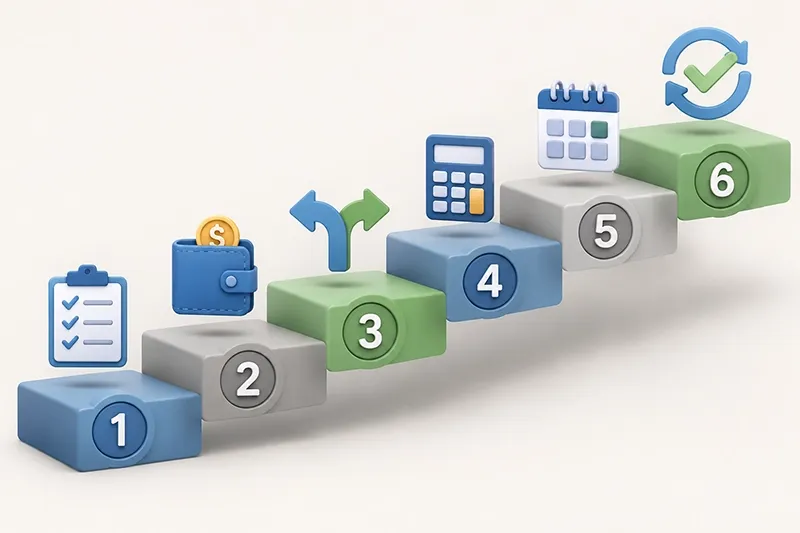
Learning how to pay off debt works best when you treat it as a repeatable monthly system rather than a one-time burst of willpower. The six steps below take you from a raw list of balances to a clear monthly schedule you can maintain without burning out.
Step 1: List Your Debts and Protect Essential Payments
Start with a simple table. For each debt, record the account type, current balance, APR, minimum payment, due date, and payment status. Most households carry a mix—such as a credit card, a personal loan, and a student loan—and each behaves differently. A revolving credit card might charge 24% APR, while a fixed-rate student loan charges 5%.
Debt Type | Current Balance | APR | Minimum Payment | Due Date | Status |
Credit Card A | $5,000 | 24% | $150 | 5th | Current |
Personal Loan | $3,000 | 11% | $110 | 14th | Current |
Student Loan | $8,500 | 5% | $95 | 22nd | Current |
In my own testing, consolidating five separate accounts into a single view revealed two small retail balances carrying higher interest than my primary card—details that were easy to miss when statements arrived on different weeks. The list did not reduce the balances by itself, but it replaced guesswork with numbers I could act on. Check due dates first, because a single late fee can wipe out the interest savings you are trying to optimize.
Start with the numbers you actually have, not the ones you estimate from memory. A $900 balance due tomorrow requires immediate attention before a larger balance that is current and under control.
Keep your debt repayment plan simple enough to update in ten minutes a month.
Step 2: Find a Monthly Payment You Can Sustain
Use a straightforward cash-flow formula: subtract your essential living expenses and required minimum payments from your monthly take-home pay. Whatever remains is your realistic debt-payoff capacity. For example, if your net income is $3,000, essentials cost $2,300, and minimum payments total $420, you have $280 left. Build your plan around a verified surplus like that—never around an unconfirmed bonus or overtime hours.
Leave a buffer for irregular expenses such as car maintenance, medical copays, or annual fees. A payment plan to pay off debt that only survives in calm months will collapse the first time an unexpected bill arrives. If you can comfortably commit an extra $120 toward debt most months, anchor your plan to $120. You can always send more during a high-cash-flow month, but you should not need a lucky month just to keep the plan intact.
Your net worth gives you a wider view of your finances, but your monthly cash flow determines what you can pay right now. You can Calculate Net Worth separately to track the bigger picture, then return to your monthly numbers to decide what goes toward debt.
Step 3: Compare Debt Repayment Strategies
The two most proven debt repayment strategies are the debt snowball and the debt avalanche. Both require paying the minimum on every account; the only difference is where your extra monthly payment goes.
Feature | Debt Snowball | Debt Avalanche |
Starts with | Smallest balance | Highest APR |
Main benefit | Quick wins and visible momentum | Lowest total interest paid |
Main drawback | May cost more in total interest | Slower early account closures |
Best for | People who stay motivated by fast milestones | People driven by mathematical efficiency |
The better method on paper is not always the one you will follow for a full year. Weigh the interest you save against the behavioral momentum you need to stay consistent. Research by Moty Amar and colleagues (2011), published in the Journal of Marketing Research, found that consumers who close out smaller balances first often remain more engaged and eliminate more overall debt, even when mathematical optimization favors a different order.
Debt Avalanche Method: Start With the Highest APR
With the debt avalanche method, your extra payment targets the balance carrying the highest interest rate while you maintain minimum payments on everything else. Consider two balances: $5,000 at 24% APR and $3,000 at 8% APR. The 24% balance generates roughly $100 in interest every month, whereas the 8% balance adds about $20. Directing extra money to the 24% balance cuts your most expensive interest drain first.
This approach minimizes total borrowing costs and works best when you are disciplined enough to stick with the routine even if your first account takes several months to clear.
Debt Snowball Method: Start With the Smallest Balance
The debt snowball method directs every extra dollar toward your smallest balance, regardless of interest rate. Once that smallest debt is paid off, you roll its entire monthly payment into the next-smallest balance. The advantage is psychological as much as financial: eliminating an account gives you a tangible win and one fewer bill to manage. If quick progress keeps you consistent, the snowball often outperforms the avalanche in practice.
Step 4: Use a Debt Payoff Calculator to Estimate Your Timeline
Enter your current balances, APRs, minimum payments, and planned extra monthly payment into a debt payoff calculator. A reliable tool returns an estimated debt-free date and total interest cost for both methods so you can compare them side by side.
Treat that payoff date as a working estimate rather than a guarantee. Variable interest rates shift, unexpected expenses happen, and income fluctuates. Recalculate whenever one of those inputs changes. You can use a simple spreadsheet or a reputable online tool—such as a standard debt snowball calculator—to model both payoff orders with the exact same numbers.
Step 5: Write Your First Month’s Debt Payoff Plan
Strategy only works when translated into a calendar schedule. Write a first-month debt payoff plan with four clear items:
- Minimum payments: Automate or schedule the required minimum on every account before its due date.
- Target debt: Name the single balance receiving your extra money.
- Extra payment amount: Specify the exact dollar figure (for example, $120) and transfer date.
- Review date: Pick one day after your statements close to verify that payments posted accurately.
For this month, pay the minimum on each account, send your extra $120 to your chosen target debt, and verify the updated balances once those payments clear. When that target balance hits zero, roll its full payment amount directly into the next debt on your list.
Execution Habit | Why It Matters |
Automate minimums + target one balance | Prevents late fees and concentrates momentum on a single account. |
Split extra cash across four cards manually | Dilutes progress and increases the chance of missing a due date. |
Step 6: Review and Adjust Your Plan Each Month
Set a 15-minute monthly check-in to verify four questions: Are the recorded balances accurate? Has your take-home pay or essential spending shifted? Have any new charges appeared? Can you still sustain your current extra payment?
If the answer to the final question is no, reduce the extra amount and preserve the habit. If your car needs repairs, this month’s extra payment may temporarily shrink—update the number and keep going rather than abandoning the system. A modest payment sustained for two years beats an aggressive target abandoned after three months. Guidance from the Consumer Financial Protection Bureau (CFPB) also emphasizes contacting lenders early if your financial situation changes, well before a payment is missed.
How to Pay Off Debt When Money Is Tight
If your budget is limited, you do not need a perfect plan to make progress. You need a plan you can repeat. Many readers feel stuck because they think they must find a large amount each month before they can start. In practice, a small, steady payment often does more than a big promise that breaks after two months.
Even a small extra payment can give your plan a direction. Pick an amount you can repeat, then revisit it when your income or expenses change. Your financial planning process should start with the cash you have today, not the cash you hope to earn later.
If You Can Make Minimum Payments but Nothing More
When the minimum payments are covered but there is little left over, start with a small extra amount, such as $25 or $40, and send it to one debt consistently. Do not promise yourself a quick payoff. A modest amount that you can send every month builds the habit, and the habit is what keeps the plan alive. Once your budget improves, you can raise the amount. Reaching the point where you can make a bigger move is one of the most effective ways to how to get out of debt fast over time, because consistency matters more than a dramatic first month.
If You Cannot Make a Minimum Payment
If the minimum payment itself is out of reach, call before the due date when possible. Ask what options are available and what each option will cost before you agree to it. Your lender or loan servicer may offer hardship programs, a payment date change, or a temporary reduction. Each option can affect your interest, fees, and credit report, so get the terms in writing. Waiting until a payment is already late usually gives you fewer choices.
If Your Income Changes From Month to Month
Irregular income makes planning harder, but it does not make planning impossible. Base your payment on a typical month, not your best month. When you earn more than usual, apply a fixed rule, such as sending half of the extra income to your target debt and keeping the rest for essentials or savings. This approach keeps your baseline realistic while still letting you use the good months. Over time, the rule can help you [how to pay off debt fast] without relying on luck.
Should You Use Retirement Savings to Pay Off Debt?

Retirement accounts can feel like an easy source of cash when debt is piling up. Some plans let you borrow from your balance or withdraw funds, and the process may look simple on the surface. However, every option carries trade-offs that can reduce your financial security for years. Before you touch retirement money, compare the immediate relief against the long-term cost and review the full rules for your specific account.
Compare Short-Term Relief With Long-Term Costs
A loan or withdrawal may free up cash this month, but it shrinks the principal that would otherwise compound for decades. Plan loans require scheduled repayment, and leaving your job can accelerate the due date. Early withdrawals often trigger ordinary income taxes and additional penalties depending on your age and distribution type. The right move depends on your employer’s plan rules, tax bracket, and income stability. Check current tax rules with an official source like the IRS or a qualified tax professional, and review our full breakdown on using 401k to pay off debt before deciding.
When Credit Cards Make Up Most of Your Debt
If most of your balance sits on credit cards, the core framework in this guide still applies: list your balances, calculate a sustainable monthly payment, and commit to one repayment order. However, card-specific mechanics—such as promotional rates, minimum payment formulas, and balance transfer fees—require closer attention.
When to Read a Credit-Card-Specific Payoff Guide
Read a specialized guide when your strategy depends on card features, such as a 0% introductory APR ending soon or a balance transfer fee that changes the payoff math. Use this article to build your foundational routine first, then explore our dedicated guide on [how to pay off credit card debt] once you know the exact numbers you are working with.
Conclusion
Debt repayment becomes manageable the moment you replace guesswork with a repeatable monthly routine. Learning how to pay off debt does not require an extreme budget or a complex spreadsheet—it requires clarity and consistency. Today, sit down and list every balance along with its APR, minimum payment, and due date. Next, calculate the exact extra dollar amount you can realistically afford to pay next month, even if that number starts small. Commit to that single target, automate your minimums, and review your progress monthly.
Was this article helpful?
Next Article
AI Shopping Assistant: How to Compare Prices, Find Deals, and Shop Smarter Online
Comments(0)
Be the first to leave a comment.