
Online shopping in 2026 is fast, but it can also leave you overwhelmed. Dozens of open tabs, shifting prices, and flashy discount banners make it hard to tell a real deal from a clever sales trick. An AI shopping assistant can help you cut through that noise. Used well, it can compare prices, find deals, and show which options actually fit your budget. In my own testing, [add your real result here].
McKinsey & Company has noted that shoppers are moving from basic keyword searches toward conversational commerce, where they describe what they need in plain language. That shift is shaping the future of AI shopping. This guide explains how these tools work, where they fail, and how to use them to shop smarter. I treat it as a practical field report, not a sales pitch, so every tip aims to support a real buying decision.
What Is an AI Shopping Assistant?
An AI shopping assistant is a digital tool that helps you research products and make better online shopping decisions. It understands natural-language requests, so you can describe what you need in plain words instead of typing exact keywords. For example, you might ask for running shoes under $100 with good arch support.
Unlike a traditional search engine, an AI-powered shopping assistant interprets the context behind your request. It can compare specifications, summarize customer reviews, and suggest alternatives. Some tools also work as an AI personal shopper, offering AI product recommendations based on your budget and preferences. Treat these suggestions as decision support, not final advice, because prices and stock change quickly.
How Does an AI Shopping Assistant Work?
An AI shopping assistant uses natural language processing (NLP) and large language models (LLMs) to understand what you mean, not just what you type. Instead of matching exact keywords, it maps the meaning of your request to products that fit. That is why a request like “a quiet blender for morning smoothies” can return useful results even when no product page uses those exact words.
Behind the scenes, the tool collects data from many merchant listings and turns it into structured information about price, features, ratings, and stock. This is what makes side-by-side comparison possible. The process feels fast, but the quality of the results depends on how complete and current that data is.
AI Product Search and Product Discovery
AI product search goes beyond exact phrases. When you describe a problem or a lifestyle, such as “tools that make weekly meal prep faster, under $150,” the model reads those conditions and returns AI shopping recommendations that match. It works a bit like an AI personal shopper, turning a loose idea into a short, relevant list.
This is where AI product discovery helps most. A search for “kitchen gadgets” returns thousands of results, while a detailed request narrows the field quickly. The system filters, groups, and ranks options in seconds, so you spend less time scrolling and more time deciding.
AI Price Comparison and Price Tracking
Many tools run AI price comparison by checking several stores at once, so you can compare prices online without opening a dozen tabs. Some also offer AI price tracking and AI price drop alerts, which notify you when an item reaches your target price or a recent low. Still, the first price you see is rarely the final one. Taxes, shipping fees, and membership conditions can change the total, so always check the final checkout page before you pay.
Product Reviews and Product Comparison
An AI review summarizer reads thousands of customer reviews and pulls out the main themes, such as durability and common complaints. This lets you compare products with AI in minutes. However, summaries can miss sarcasm, fake reviews, or a serious defect reported only a few times. Before you buy, learn how to evaluate online reviews yourself: check dates, look for repeated patterns, and be wary of reviews that sound alike. The FTC has rules that prohibit fake reviews, so reviewer authenticity matters.
How to Use an AI Shopping Assistant for Online Shopping
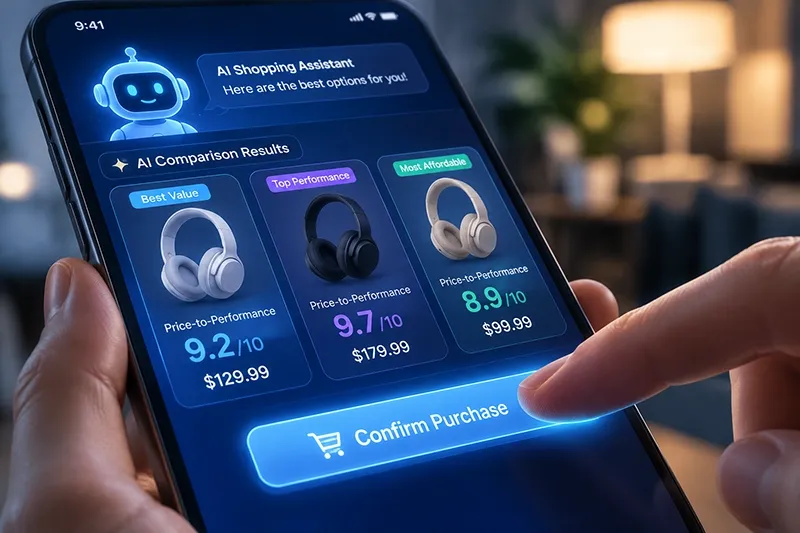
Mastering digital retail requires a practical, step-by-step operational approach. Deploying automated tools efficiently prevents decision fatigue and helps you navigate complex e-commerce environments with precision.
Start With a Clear Shopping Prompt
Learning how to use an AI shopping assistant effectively begins with framing your initial queries. A robust AI shopping prompt turns vague ideas into actionable insights during early-stage AI product research. Instead of generic searches, define your constraints precisely.
For example, rather than asking for general headphone recommendations, prompt the model with specific criteria such as budget caps, use cases, and technical features. This level of specification yields cleaner, more targeted retail options.
Compare Prices, Features, and Alternatives
Once you have a shortlist, execute a structured product comparison to evaluate metrics like durability and warranty. Integrating an automated AI price comparison model helps you find the best price across competing online storefronts without manual multi-tab tracking.
Furthermore, ask the system to surface viable product alternatives that match your functional requirements. Avoid chasing the single "best" item blindly, as optimal value always depends on individual user needs.
Find Deals, Coupons, and Price Drops
Leveraging an AI deal finder acts as a powerful coupon finder when hunting for promotional discounts. These tools excel at helping users find the best deals online while applying practical online shopping tips to save money on recurring purchases.
Always verify the final checkout total rather than trusting promotional banners blindly. Discounts often apply only to specific colors, sizes, or membership-locked inventory quotas.
Summarize Product Reviews Before Buying
Before executing a final payment, deploy an AI review summarizer to digest extensive customer reviews. This tool extracts recurring themes from raw customer feedback, separating delivery complaints from core product flaws.
Reviewing distilled sentiment summaries provides a balanced perspective superior to raw star ratings, reinforcing smart online shopping tips for modern consumers.
AI Shopping Assistant vs AI Shopping Agent
Understanding the evolution of modern retail requires examining the shift toward agentic commerce. An AI shopping assistant primarily helps users search, compare, and evaluate products. It provides recommendations, summarizes reviews, and identifies price differences, leaving the final purchasing decision entirely in the hands of the user.
In contrast, an AI Shopping Agent is engineered to take a far more active role throughout the shopping journey. Functioning as an advanced AI purchase assistant, it can search across multiple retailers, monitor price shifts, add items directly to a cart, or even prepare an order for user approval. This paradigm is deeply tied to the rise of agentic shopping and conversational commerce.
The distinction is comparable to consulting a knowledgeable retail advisor versus deploying an autonomous system to handle execution on your behalf. While future capabilities may eventually integrate an AI checkout assistant to streamline transactions, autonomy requires rigorous safeguards regarding privacy, security, and human-in-the-loop approvals. Furthermore, for everyday buyers, these autonomous workflows can extend beyond retail; for instance, users interested in streamlining household routines can explore AI for Meal Planning to connect product discovery with weekly ingredient organization.
Best AI Shopping Tools and Use Cases
Choosing the best AI shopping tools starts with one question: what do you need right now? Some platforms track price drops over time, others help you find gifts, and others examine technical details before checkout. Good tools support smarter choices, but they do not replace your judgment. The NIST AI Risk Management Framework encourages users to trust a tool only after they understand how it works and where it can fail.
AI Tools for Price Comparison and Deals
Use AI price comparison when you already know the item you want. These platforms scan several merchants at once, so you can compare prices across stores in seconds. A good AI deal finder also highlights recent price drops and coupon codes, which helps you find the best deals for online shopping.
Speed is useful, but it does not replace checking. Review shipping costs, seller reputation, warranty terms, and return policies before you pay. A low price from an unknown seller can cost more after a return. Your final total matters more than the price on the listing.
AI Personal Shopper and Gift Finder Tools
An AI personal shopper works well as an AI gift finder, especially when you need thoughtful AI gift ideas for someone you know well. Broad searches like “birthday gift” return generic results. Detailed prompts produce better artificial intelligence gifts because the tool can match interests, budget, and style. Write the request around the person, not just the occasion.
AI Tools for Product Research
AI product research becomes easier when a tool turns dense specifications into plain-language summaries. An AI shopping chatbot, or shopping with ChatGPT, can compare battery life, materials, or dimensions and suggest alternatives. These AI product recommendations save time, but they are only as accurate as the data behind them. Always check safety information, certifications, and specifications against the manufacturer’s official documentation before you buy.
How to Shop Smarter and Avoid AI Shopping Mistakes
Integrating artificial intelligence into retail brings massive advantages, but it also introduces subtle financial pitfalls. Embracing smart shopping requires understanding these operational risks. Moreover, as broader discussions in AI and Society highlight, consumer technology profoundly changes how we interact with commercial systems, making digital literacy essential for modern buyers.
Verify Prices and Product Information
Practicing smart shopping means never taking initial automated data at face value. Essential online shopping tips include cross-checking live listings through a rigorous price comparison before locking in orders. Securing the best deals online requires verifying that hidden taxes, shipping tariffs, and expiration conditions do not invalidate the advertised discount.
Do Not Trust Every AI Recommendation
One major hazard involves ignoring potential AI shopping risks. Algorithms can occasionally prioritize sponsored listings or misinterpret user intent, making blind trust in AI shopping recommendations dangerous. Thorough independent product research and a detailed AI product comparison ensure that your purchasing decisions are grounded in objective quality rather than algorithmic bias.
Avoid Impulse Buying
Flash sales, countdown timers, and instant checkout buttons are engineered to provoke instant gratification. To avoid impulse buying, adopt the discipline of a true smart shopper. Effective online shopping tips to save money include enforcing a cooling-off period before completing any non-essential online transaction.
Conclusion
Ultimately, mastering an AI shopping assistant bridges the gap between raw data overload and high-precision e-commerce. While advanced algorithms, price tracking, and conversational discovery redefine how we conduct online shopping, true financial control still rests with the human buyer. By maintaining disciplined decision-making, avoiding impulsive digital traps, and combining automation with critical oversight, modern consumers can achieve sustainable smart shopping. Explore more expert guides and tools on lifvero.com to optimize your digital life management journey.
Was this article helpful?
Next Article
10 Mindfulness Activities for Adults to Reduce Stress and Feel More Present
Comments(0)
Be the first to leave a comment.