
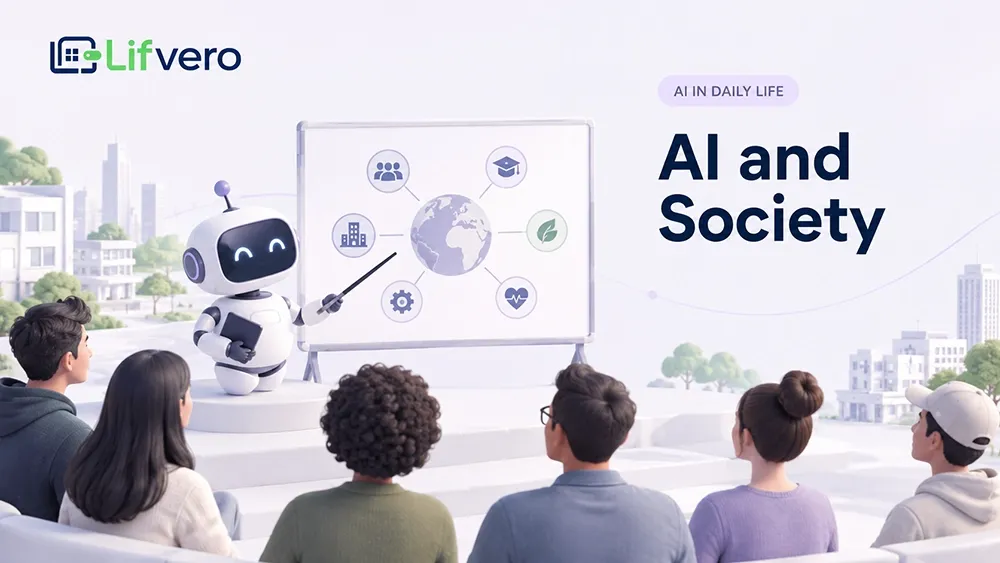
Most discussions about AI and society treat the technology like an abstract storm approaching on the horizon. But auditing my daily workflows revealed something far more immediate: artificial intelligence is already embedded in our background defaults. It shapes our schedules, triages communications, and steers micro-decisions before we consciously register them.
As machine intelligence gains momentum, a pressing question emerges: what are AI and society actually doing for us, and how is this shift rewriting our daily reality? I previously examined Artificial Intelligence Applications in Daily Life, detailing its concrete tools. Here, the focus moves beyond simple features toward the tangible transformations unfolding in our personal lives, routines, and broader culture.
The real friction is no longer about adopting new software; it is about maintaining autonomy. When cognitive effort is continuously handed over to automated systems, human intentionality risks taking a back seat. Understanding this quiet transition is essential for anyone aiming to use these tools deliberately rather than living on algorithmic autopilot.
AI and Society: How Everyday Life Is Changing
The true measure of AI in modern society is not found in headline-grabbing breakthroughs, but in how silently it modifies our daily conduct. We rarely stop to consider whether an algorithm should arrange our day; we simply yield to its frictionless momentum. The structural relationship between AI and society is transitioning from conscious tool usage to default behavioral compliance.
How AI Is Changing Daily Routines
The real impact of AI on human life appears in tiny, repeated micro-habits. Contextual commute routing, auto-completed messages, and algorithmic playlists remove everyday friction. Yet eliminating all friction comes with a cognitive cost. When every daily transition is automated, our capacity to navigate ambiguity, boredom, and spontaneous choices begins to atrophy.
Productivity Tip — The Cognitive Checkpoint
Run a weekly friction audit across your tools. Disable predictive auto-replies on non-urgent communication for three days. Restoring deliberate friction prevents mindless passive execution.
AI and Society: Changes in Work and Productivity
Inside modern workflows, artificial intelligence in today's world shifts our primary role from creators to full-time editors. Generative systems draft outlines, write code snippets, and compile datasets in seconds. However, this shift creates a dangerous verification bottleneck: verifying probabilistic outputs often demands more cognitive stamina than executing raw work manually.
As documented by the McKinsey Global Institute, generative systems automate routine tasks that once consumed up to 70 percent of employee time. But this automation does not erase effort; it reallocates it entirely toward verification, domain expertise, and strategic judgment.
How AI Is Transforming Education and Learning
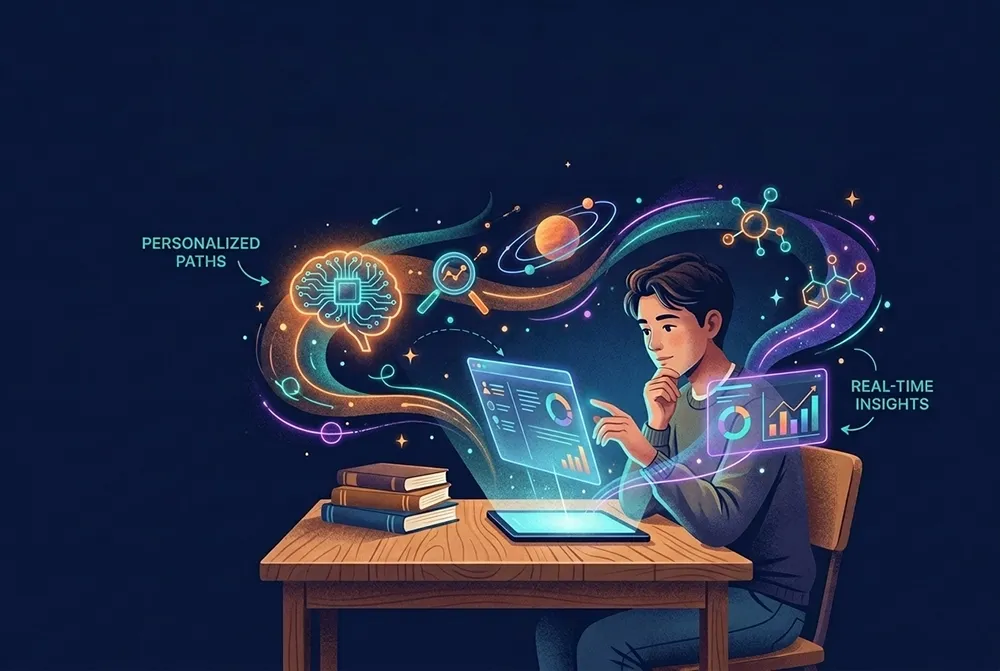
Instant information retrieval has fundamentally disrupted the mechanics of study. In our current landscape of AI and society, learners no longer wrestle with fragmented library indexes or manual notes. Yet, skipping the messy phase of research carries hidden trade-offs for deep memory retention. The true importance of artificial intelligence in learning lies not in generating immediate shortcuts, but in challenging assumptions through interactive dialectic inquiry.
Personalized Learning and Access to Information
With artificial intelligence nowadays, study workflows adapt instantly to individual reading levels, breaking down convoluted papers into accessible summaries. However, smooth syntactical fluency frequently creates an illusion of competence. Reading a neatly summarized answer is not the same as mastering the foundational logic behind it.
As highlighted by the UNESCO Framework on Digital Competencies, educational systems must prioritize learner agency over automated consumption. True technical mastery requires struggling through edge cases rather than accepting unverified synthesis from a conversational prompt.
How AI Influences Human Decisions and Communication
Automated sorting mechanisms quietly narrow the scope of human interaction. From screening applicant resumes to shaping social discourse and drafting delicate client correspondence, delegating delicate communication to an AI society strips away subtle emotional context. The broad impact of artificial intelligence on decision-making is that it optimizes for statistical probability rather than nuanced human compassion.
Computer science pioneer Joseph Weizenbaum warned in Computer Power and Human Reason that choice is an act of judgment, not mere calculation. When algorithms dictate which perspectives reach our screens, human agency is reduced to selecting from machine-curated suggestions. Preserving interpersonal trust means keeping vital human decisions independent of automated scores.
The Benefits of AI for Society
When applied with strict operational boundaries, the concrete artificial intelligence benefits to society are substantial. The core reason why artificial intelligence is good for modern infrastructure is leverage: it condenses months of pattern recognition and administrative triage into seconds. These capabilities allow human operators to focus their limited bandwidth on high-stakes critical dilemmas.
How AI Improves Efficiency and Accessibility
In public accessibility and clinical operations, machine learning processes multi-modal inputs at scale. Vision models transcribe environmental cues for visually impaired users, real-time audio translates dialects seamlessly, and diagnostic pipelines accelerate early anomaly detection across radiology scans.
To extract reliable upside while minimizing deployment vulnerabilities, engineering teams rely on structured governance baselines such as the NIST AI Risk Management Framework. Clear protocols keep automated leverage balanced against operational safety.
Where AI Excels (High Leverage) | Where AI Fails (High Fragility) |
Rapid data normalization and structured synthesis | Nuanced contextual judgment and ethical discernment |
Real-time multimodal accessibility support | Verifying nuanced ground truth without hallucinations |
Accelerating early anomaly detection in large datasets | Empathy, emotional resonance, and genuine accountability |
The Negative Impacts of AI on Society
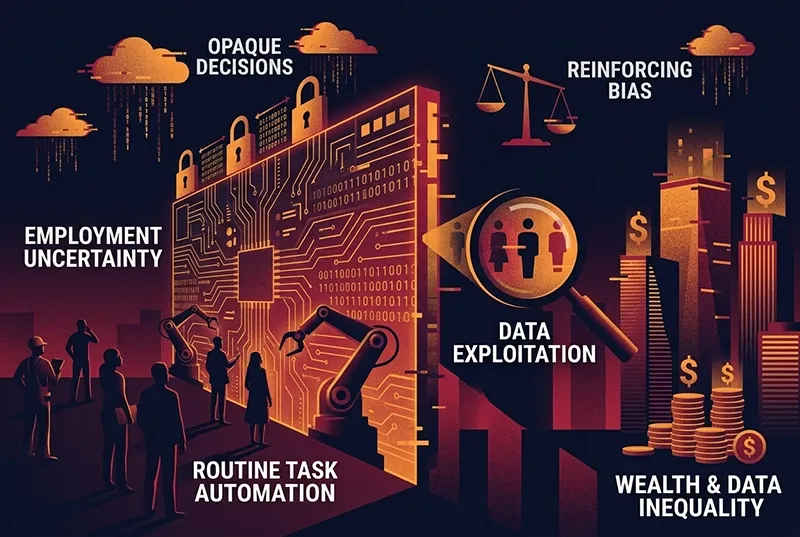
Over-optimistic adoption often blinds organizations to serious systemic vulnerabilities. The documented negative impacts of artificial intelligence on society run deeper than surface-level software bugs. When automated systems ingest messy real-world data without strict human boundaries, they quietly perpetuate historical inequities. Critiques arguing that unvetted AI is bad for society highlight a genuine structural crisis: unaccountable algorithmic systems making life-altering choices behind proprietary walls.
Privacy, Bias, and Misinformation
Massive web-scraping practices have turned everyday digital footprints into proprietary training fodder without consent. In The Alignment Problem, Brian Christian demonstrated that machine learning algorithms do not simply discover neutral patterns; they absorb, encode, and amplify our cultural blind spots under a facade of mathematical certainty. Without proactive controls, automated hiring screeners and credit-scoring tools quietly discriminate against underrepresented groups while synthetic media pollutes public discourse.
AI and Society: The Risks of Overreliance
Within professional teams, unchecked automation nurtures a dangerous cognitive hazard known as automation bias. When engineers and analysts habitually defer to model-generated outputs without manual verification, foundational domain skills steadily erode. In the long-term interaction between AI and society, the greatest vulnerability is not conscious machine rebellion, but self-inflicted human atrophy—losing the hard-won ability to debug systems, reason through first principles, and challenge machine calculations.
The Future of AI and Society
Grounded strategic planning requires looking past dystopian panic and marketing promises alike. Analyzing the actual trajectory of AI and society reveals that tomorrow's landscape will not feature science-fiction sentience. Instead, the immediate artificial intelligence future centers on coordinated autonomous systems quietly executing complex, multi-stage workflows across personal calendars, supply chains, enterprise infrastructure, and research labs with minimal human intervention.
How Will AI Change the World in the Coming Years?
Curious observers routinely ask: how will AI change the world over the next decade? The proliferation of autonomous agents and new technology in artificial intelligence will commoditize generic drafting, data formatting, and boilerplate software engineering. As raw content production costs drop toward zero, an unprecedented strategic premium will shift toward authentic taste, domain-tested expertise, and accountable human integrity.
How People Can Adapt to an AI-Driven World
Thriving alongside modern artificial intelligence requires treating automation as an amplifier rather than an intellectual crutch. The growing tension between AI and society comes down to personal operating discipline. To prevent algorithmic convenience from eroding your critical thinking, ground your daily workflow in intentional personal systems:
- Practice Input Hygiene: Never feed sensitive personal credentials, private client records, or unencrypted architectural roadmaps into public large language models. Treat every digital prompt as public exposure.
- Retain First-Principles Reasoning: Outline strategic decisions, technical architectures, and creative problems on paper before turning to machine synthesis. If you outsource early structuring, you forfeit your core domain advantage.
- Reclaim Deliberate Planning: Meaningful digital balance begins with personal sovereignty. Revisit foundational life design principles by asking What Is Life Management? to build resilient habits that keep technology serving human priorities rather than defining them.
Frequently Asked Questions About AI and Society
How Does AI Impact Our Daily Lives?
Artificial intelligence shapes daily life by automating repetitive logistics, curating digital communications, optimizing travel routes, and tailoring content consumption. While this invisible background assistance dramatically reduces friction, it alters attention spans and demands deliberate effort to maintain independent decision-making and personal agency.
What Is the Impact of AI on Society?
AI drives major gains in research, productivity, and accessibility across healthcare, software engineering, and operations. However, it also introduces systemic friction—including workforce displacement, algorithmic bias, privacy vulnerabilities, and synthetic misinformation—requiring clear ethical oversight, continuous human judgment, and transparent accountability protocols.
Conclusion
Navigating the evolving relationship between AI and society requires recognizing machine intelligence as a powerful cognitive amplifier rather than an infallible authority. Algorithms can streamline complex data pipelines, draft operational summaries, and accelerate administrative logistics at unprecedented speed. However, genuine progress depends on human oversight. Without disciplined personal systems, clear ethical boundaries, and active verification habits, passive reliance on synthetic outputs inevitably erodes our critical discernment and independent problem-solving capabilities.
Moving forward in an automated world calls for intentional self-management and cognitive ownership. Artificial intelligence reflects the goals, data, and constraints we assign to it; it cannot replicate authentic empathy, lived experience, or moral accountability. By applying automation to routine mechanics while reserving strategic judgment, deep curiosity, and personal values for ourselves, we ensure modern technology serves our long-term growth rather than dictating how we live.
Was this article helpful?
Next Article
How to Stop Feeling Overwhelmed With Life: Practical Steps That Help
Comments(0)
Be the first to leave a comment.