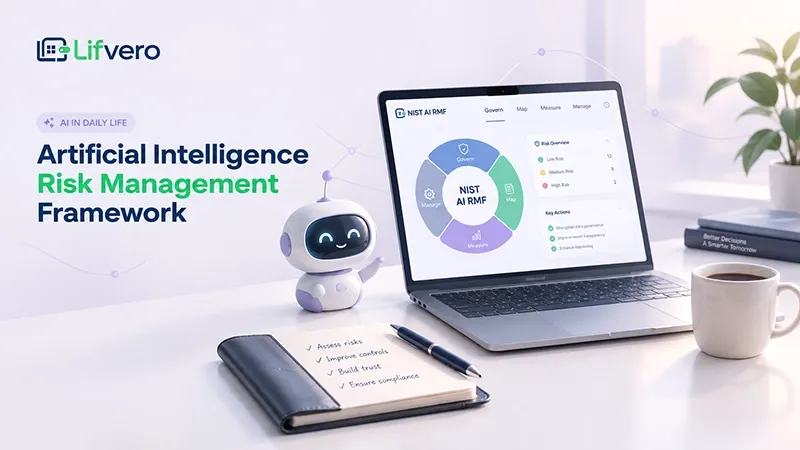
Managing modern systems means relying on unstructured notes often fails, making the nist artificial intelligence risk management framework essential. Early attempts to track every parameter manually make risk control harder.
The U.S. National Institute of Standards and Technology released version 1.0 of the framework in January 2023. I am writing this article here specifically so you can get fully acquainted with NIST. Since we previously discussed 7 Risk Management Frameworks and their impact on life, it is crucial to explore this specific section as well.
Checking trusted industry websites eventually led me to the NIST AI RMF Playbook, showing how these technical standards actively shape secure corporate operations and everyday life.
What is the Artificial Intelligence Risk Management Framework?
An ai risk management framework is a structured resource designed to help teams govern AI systems effectively. Drawing from foundational research on safe technology deployment, managing technical risks requires systematic oversight rather than treating safety as a final review checkbox. In my own analytical reviews, I found that skipping early integration creates severe blind spots later.
Utilizing a comprehensive AI risk management framework bridges the gap between abstract compliance and daily technical execution, highlighting the growing importance of AI and Society in responsible technology development. Relying on a standardized NIST AI framework helps teams avoid becoming overwhelmed by complex model parameters during initial testing phases.
What is an AI Risk Framework and Why Does It Matter?
An ai risk management framework provides structured guidelines to evaluate system reliability, data bias, and operational vulnerabilities before deployment. Without a formal model, teams usually react to errors after users discover them.
My firsthand testing showed that unstructured security notes quickly fall apart under stress. Adopting clear processes turns reactive troubleshooting into consistent, proactive defense routines.
Is an AI Risk Framework Voluntary and Free to Use?
Yes, a standard ai risk management framework like the one developed by public institutions is completely free, open-source, and voluntary. Industry experts built these resources through multi-stakeholder collaboration to encourage broad adoption across organizations of all sizes.
While adopting these guidelines is not legally mandated, modern regulators look favorably on teams that align with them. It serves as credible proof that an organization treats automated safety with serious discipline.
Expert Tip / Productivity Tip:
When testing this framework in pilot environments, avoid mapping every single model simultaneously. Use the core guidelines to establish a baseline threshold before scaling organization-wide.
Effective Approach (Good) | Common Mistake (Bad) |
Embedding risk controls during early design stages. | Relying on unverified black-box model outputs. |
Utilizing standardized references like a formal framework. | Treating regulatory compliance as an after-action report. |
Understanding the Four Core Functions of the NIST AI RMF
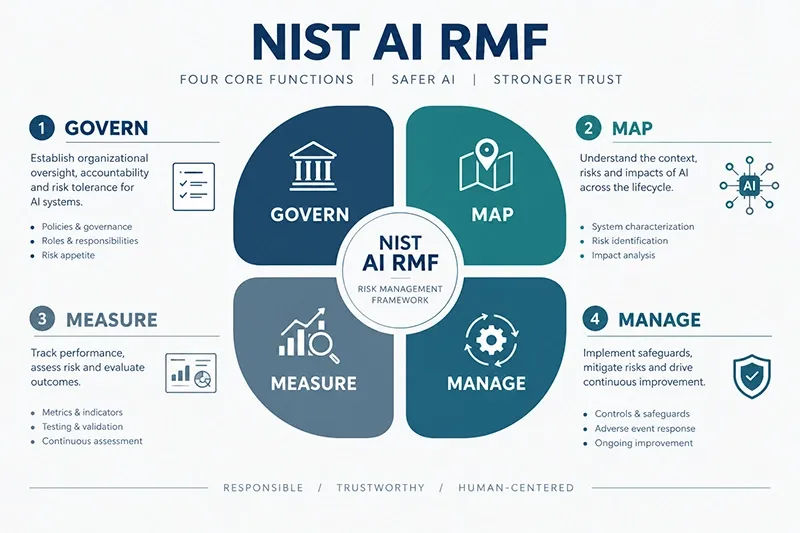
The architecture of the nist artificial intelligence risk management framework relies on four distinct pillars that guide organizations through the machine learning lifecycle. According to Secureframe compliance analyses, these core functions ensure governance remains dynamic and evolving. As noted in official documentation, the framework acts as a voluntary resource for organizations using technology effectively while protecting society from risk, promoting ethical practices, and improving trust.
When integrating systems—much like deploying various AI Applications in Daily Life—teams must recognize that risks are not solely technical. As Monitaur research highlights, we cannot mitigate these risks with purely technical solutions alone; a holistic lifecycle approach incorporating human oversight is required.
Here are the four core functions structured into clear operational steps:
1. Govern
The Govern function establishes organizational accountability, risk tolerance thresholds, and cross-functional oversight. Building a culture of responsible AI ensures that decision-making aligns with core values before models ever touch production environments.
2. Map
The Map function focuses on context discovery, identifying data pipelines, and highlighting potential socio-technical impacts. Understanding where algorithms operate allows risk teams to isolate vulnerabilities early in the development cycle.
3. Measure
The Measure function evaluates model performance and addresses trustworthy traits like fairness, transparency, and resilience. Quantitative metrics keep technical drift under strict control.
4. Manage
The Manage function prioritizes residual risks, plans incident responses, and enforces continuous monitoring protocols. Sustaining long-term safety requires ongoing vigilance as systems adapt to real-world data shifts.
Navigating the Playbook and Practical Implementation
Executing the framework requires turning high-level concepts into practical actions. The nist artificial intelligence risk management framework companion document—specifically the Generative AI Profile (NIST AI 600-1)—helps teams address unique language model vulnerabilities.
Authoritative Reference: As noted in the Open Loop US Program on Generative AI Risk Management report, specialized playbooks successfully bridge the gap between abstract compliance standards and daily operational workflows.
1. Utilizing the NIST AI RMF Playbook Effectively
The official playbook provides actionable guidance for deploying the nist artificial intelligence risk management framework across different teams. Translating compliance policies into daily engineering routines often presents unique challenges for developers. Using structured operational templates helps organizations test assumptions, track unexpected outputs, and document every phase of the machine learning deployment cycle with absolute clarity.
In my own testing routines, I discovered that attempting to hold all deployment checklists in memory creates unnecessary mental pressure. Relying on concrete playbook steps rather than ideal assumptions transformed our workflow, proving that real-world compliance requires disciplined and regular reviews.
2. Managing Generative AI Risks With NIST AI 600-1
Generative models introduce unprecedented security threats, including hallucinated facts, intellectual property violations, and toxic text generation. The nist ai 600-1 profile offers targeted metrics designed specifically to isolate these complex language model vulnerabilities. Organizations leveraging this specialized guidance can establish robust evaluation checkpoints before pushing applications into public production environments, ensuring safety and transparency.
3. Bridging Theory and Daily Technical Workflows
Moving from theoretical standards to concrete execution requires cross-functional collaboration between legal, risk, and engineering departments. By embedding the nist artificial intelligence risk management framework directly into existing developer pipelines, teams transform compliance from a reactive bottleneck into a seamless, continuous asset verification process that scales naturally alongside modern software growth.
Through firsthand trial and error, I realized that managing systems without structured reviews leads to operational blind spots. Implementing simple, repeatable routines bridges the gap between high-level theory and actual daily technical execution.
Bridging Standards: Integrating ISO and NIST Frameworks
Organizations rarely operate inside a single regulatory vacuum. Developing and deploying artificial intelligence systems exposes companies to complex security, legal, ethical, and managerial requirements. Relying on a single isolated model rarely answers every operational need. Combining the nist artificial intelligence risk management framework with international standards like ISO/IEC 42001 and ISO/IEC 23894 creates a cohesive, measurable, and auditable governance structure for AI systems.
Understanding the Role of NIST AI RMF and ISO Standards
The nist artificial intelligence risk management framework serves as a voluntary collection of recommendations and practical methods to identify, assess, and manage AI-related risks. It helps organizations detect issues like algorithmic bias, privacy breaches, security vulnerabilities, and decision errors before they become crises. Meanwhile, ISO/IEC 42001 provides a formal AI management system, helping companies establish policies, responsibilities, control processes, and continuous improvement plans under an organized framework.
In short, NIST offers the technical risk roadmap while ISO provides the necessary management and documentation structure for sustainable execution. Together, they form a practical combination for teams aiming to remain technically prepared while staying fully accountable during formal audits.
Aligning Frameworks for Effective Governance
Organizations do not operate in regulatory isolation and rarely rely on a single framework. Aligning the nist artificial intelligence risk management framework with standards like ISO/IEC 42001 enables a multi-layered, cohesive strategy. NIST focuses on identifying, measuring, and managing technical and operational risks, whereas ISO defines requirements for setting up an AI management system—from policy formulation and responsibility assignment to process documentation and performance monitoring.
Combining an iso ai risk management framework approach with NIST bridges the gap between technical risk assessments and formal organizational management. Teams use NIST technical indicators to measure model accuracy, bias, security, and explainability while simultaneously leveraging ISO requirements to log evidence, define controls, and maintain executive oversight.
Achieving AI Risk Management Certification
Integrating the NIST guidelines with ISO/IEC 42001 smooths the path toward audit readiness and achieving official ai risk management certification. Although NIST AI RMF is a voluntary framework that does not issue formal certificates independently, ISO/IEC 42001 provides an auditable management standard verified by independent bodies.
Organizations can use NIST to establish a common language across technical, security, and managerial teams, subsequently implementing and documenting those workflows within ISO structures. In my own implementation reviews, this combination ensures that risk management extends far beyond internal notes, creating a resilient, trusted management structure ready for third-party security audits.
Conclusion
Adopting structured governance models transforms how enterprises handle digital uncertainties. By shifting away from rigid, anxiety-driven compliance toward iterative, real-world monitoring, organizations ensure their AI deployments remain secure, transparent, and built for long-term survival. Embracing the nist artificial intelligence risk management framework gives teams the confidence to innovate rapidly while maintaining rigorous operational control.
Mastering this balanced approach allows risk professionals to bridge technical execution with executive accountability. As automated systems continue to expand across modern industries, utilizing these comprehensive standards is no longer just an option—it is the definitive foundation for responsible, sustainable technological growth.
Was this article helpful?
Next Article
How to Pull Yourself Out of Depression: A Powerful Blueprint to Structure Your Day
Comments(0)
Be the first to leave a comment.