
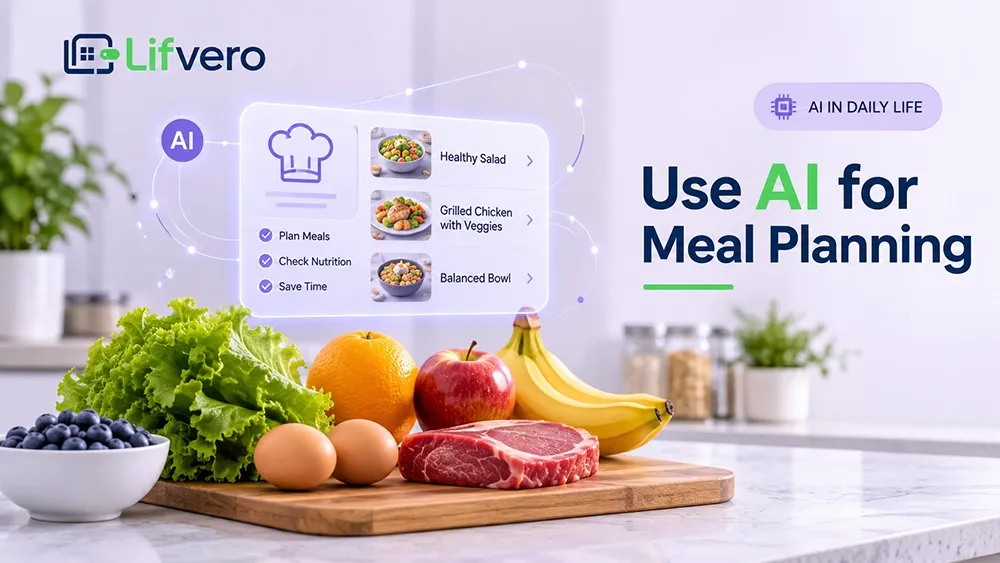
Effective meal planning is foundational to intentional daily life management—so much so that adding a nutrition platform to Lifvero has become a roadmap priority for our product team. I love diverse food, but when the week starts, I often have no idea what to cook. Building a meal plan for weight loss feels exhausting when I balance calories and groceries. AI meal planning helps: an AI meal planner or AI diet planner turns my goals into a weekly plan.
What Is AI Meal Planning?
AI meal planning uses machine learning to create meal ideas and structured eating schedules based on your specific requirements. You provide inputs like calorie targets, dietary restrictions, favorite ingredients, available cooking time, household size, and budget. An AI meal planner then processes these parameters to suggest coordinated daily meals, step-by-step recipes, portion guidance, and a ready-to-use grocery list.
The primary value is eliminating evening decision fatigue. Instead of staring at an empty pantry, an AI meal plan generator builds a tailored weekly framework in seconds.
However, AI does not replace a doctor or a registered dietitian. Treat it strictly as an administrative planning assistant. For underlying medical conditions or complex metabolic needs, always have a healthcare professional review the output.
AI meal planning excels at:
- Generating fresh meal combinations from ingredients you already own
- Structuring breakfast, lunch, dinner, and snacks across the week
- Cutting daily cognitive load around dinner choices
- Compiling an organized, categorized shopping list
- Aligning your meal schedule with actual cooking time and budget
How to Create a Meal Plan for Weight Loss With AI
A meal plan for weight loss succeeds only when your inputs are precise. Vague prompts like "give me a healthy diet" yield bland, unsustainable suggestions that lead to quick burnout. The AI needs clear operational boundaries to construct a practical routine.
Define Your Weight-Loss Goal
To build an effective diet plan for weight loss, provide the model with your exact targets, daily rhythm, and food boundaries. The more context you provide, the better the system balances nutrition and convenience.
Ensure your initial prompt includes:
- A realistic weekly target, such as steady fat loss of 0.5 kg per week
- Preferred meal frequency, including planned snacks
- Daily activity level, from desk jobs to intense strength training
- Severe allergies, food intolerances, and strict dislikes
- Realistic cooking time limits for busy weeknights versus weekends
Ask for Healthy Meals for Weight Loss
Instruct the system to build healthy meals for weight loss centered on protein, dietary fiber, and high-volume vegetables. Sustainable fat loss requires satiety; simply cutting portion sizes to starvation levels triggers rebound eating and metabolic fatigue.
Avoid extreme deficits or overly restrictive regimes that eliminate entire food groups without a medical reason. If an AI meal plan for weight loss suggests tiny portions that leave you constantly hungry, prompt it to increase vegetable volume and lean protein while keeping calories stable.
Weekly Meal Planner, Weekly Food Planner, and AI Diet Planner
An AI diet planner can organize breakfast, lunch, dinner, and snacks across several days without hours of manual sorting. If you prefer to plan by hand, a weekly meal planner, weekly food planner, or weekly menu planner still helps you structure meals and avoid last-minute takeout. If you already use the best AI personal assistant for daily tasks, you can ask it to add prep time and grocery reminders to your calendar.
How to Generate Meal Plan Ideas for the Week
If you need meal plan ideas for the week, ask the AI to create seven days of meals using affordable, seasonal, and familiar ingredients. Ask it to reuse ingredients across recipes, such as roasted chicken in salads, wraps, and grain bowls. This reduces food waste and lowers your grocery bill. Check the portions and prices against your local market, because AI suggestions often assume ingredients you cannot easily find.
Creating a Weekly Family Meal Plan
A family meal planner should consider different ages, tastes, allergies, and portion sizes. Ask the AI to create a weekly family meal plan with flexible base dishes that you can adjust for children, adults, vegetarians, or anyone following a specific diet. If you want a free starting point, a family meal plan generator free option can give you a draft. Review allergies carefully before you cook.
AI Meal Planning Tools: Specialized Apps vs General AI
When establishing an automated kitchen routine, users typically choose between two architectural approaches for AI meal planning. Specialized meal-planning applications operate on structured relational databases paired with strict macro calculators, providing instant recipe scaling, automated nutrition metrics, and direct grocery cart integrations. On the other hand, general AI models like ChatGPT, Gemini, Claude, and Grok offer unmatched conversational flexibility, letting you invent creative recipes around obscure pantry leftovers or rebalance schedules on the fly. However, because general models lack verified nutritional databases, they require diligent fact-checking and macro verification before you commit to their numbers.
Best Specialized AI Meal Planner Tools
Selecting the best ai meal planner is never a one-size-fits-all decision; the optimal platform depends strictly on your metabolic goals, household size, culinary skill, and tolerance for manual data entry. Below are six established industry tools that solve different friction points across the planning pipeline, ranging from automated calorie engines to manual recipe organizers.
1. Eat This Much
Eat This Much functions as a mathematical calorie and macro solver designed for hands-off planning. You set daily caloric ceilings and macro ratios, and the algorithm automatically compiles daily meals matched to your budget and prep availability. It serves as a benchmark choice for users searching for a dedicated ai meal planner for weight loss, though you should always verify that its suggested portion sizes remain practically satisfying for your daily appetite.
2. Samsung Food
Formerly known as Whisk, Samsung Food excels as an end-to-end recipe aggregator, kitchen organizer, and shopping assistant. It enables you to clip recipes across social media platforms, organize them across a calendar, and export a consolidated meal plan with grocery list directly into delivery services. It is best suited for visual cooks who already have a growing recipe backlog and need a unified dashboard to streamline weekly procurement.
3. Fitia
Fitia pairs structured calorie targets with smart nutrient tracking tailored for progressive body composition goals. It helps users maintain a steady caloric deficit while automatically deriving organized ingredient quantities for the supermarket. While its macro precision is valuable for fitness tracking, the granular logging interface can feel demanding if your primary goal is simple, low-friction dinner ideation.
4. PlateJoy
PlateJoy focuses on hyper-personalized curation, making it an effective choice for complex medical diets, multi-allergen households, and low-FODMAP protocols. The platform requires a comprehensive onboarding assessment to calibrate ingredient exclusions, but the resulting bespoke menus significantly reduce allergen risks across family members. Keep in mind that setup requires patience, and severe allergies should always be cross-checked manually against raw packaging.
5. Mealime
Mealime eliminates decision fatigue through simplicity, focusing on low-prep recipes that take thirty minutes or less to cook. You select a curated set of meals for the week, and the engine immediately compiles an organized shopping list with near-zero food waste. While it lacks deep computational calorie optimization or generative recipe modification, it remains an ideal low-friction solution for busy professionals and beginners.
6. Paprika 3
Paprika 3 is an offline recipe manager and grocery utility rather than a generative AI system. It excels at scraping raw text from any cooking site, stripping away digital clutter, and letting you manually drag meals onto an integrated calendar. For cooks who prefer complete manual control without ongoing monthly subscriptions or generative AI intervention, it remains the gold standard digital recipe binder.
Using ChatGPT, Gemini, Claude, and Grok for Meal Planning
You do not always need a dedicated app to plan your meals. General AI assistants such as ChatGPT, Gemini, Claude, and Grok can build useful plans when you give them clear instructions. They are especially helpful for brainstorming recipes, adapting meals to ingredients you already have, and turning a plan into a shopping list. If you want to see how AI applications in daily life can simplify routine tasks, meal planning is a practical place to start.
Master Prompt for a 7-Day Weight-Loss Meal Plan
A vague request usually produces generic suggestions. A structured prompt gives the model limits to work within, so the result is easier to use. Copy this prompt and adjust it to match your budget, allergies, and cooking time.
Act as an experienced meal-planning assistant. Create a 7-day meal plan for weight loss for one adult.
Key Parameters:
- Structure: 3 meals and 1 snack per day (around 1,700–1,800 daily calories).
- Nutrition: High protein (at least 120g/day) and high dietary fiber (30g+/day).
- Time limit: Dinners must take under 30 minutes of active prep.
- Dietary exclusions: Strictly avoid peanuts and shellfish.
- Pantry focus: Prioritize budget-friendly, common ingredients and cross-utilize staples.
- Deliverables: Include estimated portion sizes, simple prep steps, and a consolidated, categorized grocery list at the end.
Conversational AI is fast and flexible. You can request quick ingredient swaps, revise a single day without rebuilding the whole plan, and use leftovers from your fridge. Basic chat features are often free, although usage limits and paid tiers vary by provider. These tools also work well for creative recipe ideas.
Their weaknesses matter just as much. Calorie and macro estimates can be wrong, so verify them before you rely on them. Most general assistants do not have barcode scanners or built-in tracking. They may also suggest hard-to-find ingredients, and they do not warn you about cross-contamination. Always check allergen labels yourself.
Create a Meal Plan With Grocery List
A meal plan is only useful if you can shop from it. Ask the AI to create a meal plan with grocery list that combines duplicate ingredients, estimates quantities, and rounds up amounts so you do not run short. A weekly meal planner with grocery list reduces impulse buying and helps you use what you buy before it spoils.
Ask the model to sort items into supermarket sections, such as produce, protein, dairy and alternatives, grains and pantry items, frozen foods, and spices and sauces. This order follows the layout of most stores, so you can move through the aisles faster and keep the list short.
What About Nutrisystem Meals and HelloFresh Meals This Week?
Some people search for branded options like Nutrisystem meals or HelloFresh meals this week because they want convenience. These services can save preparation time, but they work differently from an AI planner. Nutrisystem sells mostly pre-packaged diet meals with set portions. HelloFresh delivers pre-measured ingredients and recipe cards for each box.
An AI planner gives you more control over your budget, the ingredients you choose, your dietary needs, and your family’s preferences. It is not the same product as a meal kit or a diet program, so treat these options as separate choices. Compare cost per serving, delivery schedule, and packaging before you decide which one fits your routine.
Conclusion
Sustainable nutrition is never about finding a mathematically flawless algorithm; it is about reducing the daily cognitive friction that causes diets to collapse by mid-week. Leveraging AI meal planning allows you to offload the repetitive mental burden of calculating deficits, inventing recipes, and organizing supermarket runs, freeing up bandwidth for the actual habit of cooking wholesome food. Whether you deploy an automated engine like Eat This Much or rely on custom-prompted models like ChatGPT, treat AI as an adaptable administrative partner rather than a rigid prescription. A realistic, flexible system you can comfortably sustain through busy weeknights will always deliver better long-term health outcomes than an overly strict plan abandoned at the first hurdle.
Was this article helpful?
Next Article
How to Do a Social Media Detox: Practical Ways to Scroll Less
Comments(0)
Be the first to leave a comment.