

Risk management frameworks often sound like corporate jargon, yet they answer the most frustrating question in personal life: why do our best-laid plans collapse the second reality hits? For years, I treated my calendar like an ironclad contract, failing to realize that plans aren’t static—they’re dynamic. When life throws a curveball—a sudden project pivot or personal emergency—a brittle schedule shatters. The issue isn’t your effort; it’s the lack of a risk-aware architecture.
We often treat stability as a compliance exercise, just filling boxes. If you’ve ever dug into the work of Robert S. Kaplan and Anette Mikes, they hit on a painful truth: “Risk management is too often treated as a compliance issue that can be solved with rules. But no rule book can prevent disasters caused by external events.” They aren’t wrong. Rigid checklists fail because they ignore the unpredictable nature of our environment, leaving us blind to the risks that actually matter.
True resilience isn’t about avoiding all risk; it’s about understanding it. As ISO 31000:2018 notes, the purpose of managing risk is “the creation and protection of value.” It’s time to move beyond simple productivity and build a governance system that withstands chaos. We are going to adapt COSO ERM and NIST strategies into a personal operating system—one that doesn’t just manage your tasks, but safeguards your life against the inevitable friction of the real world.
What Risk Management Frameworks Really Are (And Why Most People Misuse Them)
Most people assume risk management is about “avoiding” bad things. This is the single biggest trap in personal strategy. If you view risk through a lens of fear—trying to prevent every possible negative outcome—you end up paralyzed. Real frameworks, like those outlined in global governance standards, aren’t about eliminating uncertainty. They are about navigating it to protect what you value most.
A repeatable loop for uncertainty (The ISO 31000 foundation)
ISO 31000 defines risk simply as “the effect of uncertainty on objectives.” This is brilliant because it admits something standard planners ignore: you cannot control the outcome, but you can control your response to the deviation. Most people treat risk management like a one-time project, filling out a spreadsheet once and forgetting it. That is not risk management; that is a filing error.
A true framework is an iterative loop. It is not something you “do” once a year; it is a system that recalibrates every week. When your objectives shift, the uncertainty around them shifts too. If your system doesn’t have a feedback loop—where you constantly monitor how current events are deviating from your goals—you aren’t managing risk. You are just guessing.
Outcomes over controls: Why frameworks prevent crises, not risk
We often conflate “controls” with “safety.” We set recurring alarms, color-code calendars, and install productivity apps, thinking these are risk mitigations. They aren’t. They are just administrative overhead. A control is a tactic; a framework is a strategy. If you focus only on the control—the specific task list or the app—you miss the bigger picture of why your strategy is failing.
The “Control” Trap (Bad) | The “Framework” Mindset (Good) |
|---|---|
Focuses on ticking boxes to feel busy. | Focuses on safeguarding core objectives. |
Breaks down when a crisis hits. | Anticipates disruption as a standard variable. |
Requires constant willpower to maintain. | Integrates naturally into your weekly flow. |
The goal of a framework, as suggested by COSO ERM principles, is to integrate risk into your strategy-setting. You aren’t trying to prevent risk; you are trying to prevent crises. If you identify a potential bottleneck in your week and adjust your energy allocation before it hits, you have successfully used a framework. You didn’t stop the risk; you neutralized the impact.
The friction law: If your system demands willpower, it is already broken
If you need a burst of motivation to manage your risks, your framework is too heavy. The most effective systems for managing uncertainty act like a background operating system. They shouldn’t feel like a chore. NIST CSF 2.0 emphasizes the “Govern” function—setting expectations and priorities so that risk-based decisions happen almost automatically.
Productivity Tip: Stop treating risk management as a “Saturday morning review.” Instead, apply the “Pre-Flight” check. Every Sunday, ask yourself one question: “What is the one objective I am pursuing this week that is most vulnerable to an external shock?” By identifying that single point of failure, you govern your week without needing massive willpower.
The 7 Risk Management Frameworks: A Practical Field Guide
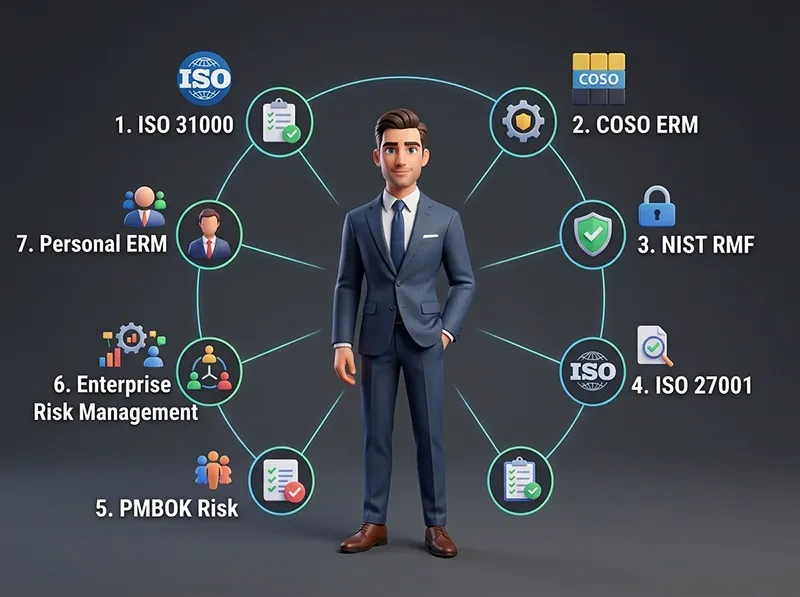
Most people encounter risk models when a project derails or an audit approaches. But treating uncertainty as an afterthought is dangerous. To master chaos, you need battle-tested systems. Here is how the most respected global risk management frameworks function—and how to scale them down into your everyday decisions.
ISO 31000: The principles-based engine for value protection
The ISO 31000 risk management standard is not a rigid checklist of compliance rules; it is a flexible, principles-based system. At its foundation lies a modern understanding: the official risk definition in risk management is simply “the effect of uncertainty on objectives.” This deviation can be negative, positive, or both.
Instead of obsessing over endless hazards, ISO 31000 focuses on creating and safeguarding value. In everyday life, this means auditing your high-priority goals—whether completing a career transition or hitting a personal milestone—and spotting external frictions before they become full-blown disruptions.
Framework | Primary Focus | Best Personal Application |
|---|---|---|
ISO 31000 | Value creation & protection | Weekly goal prioritization & setting buffers |
COSO ERM | Strategy & Risk Appetite | Long-term career shifts & financial commitments |
COSO ERM: Aligning risk appetite with high-level strategy
The COSO ERM framework (Enterprise Risk Management) focuses heavily on how uncertainty interacts directly with strategic direction. An enterprise risk management framework connects your broader vision with everyday execution, ensuring you don’t take risks that undermine your core foundation.
Central to the ERM framework is the concept of Risk Appetite—the amount of uncertainty you are actively willing to accept. In personal finance, working with a certified Financial Planner requires knowing this threshold clearly. If you quit your day job without an emergency fund, your strategy exceeds your appetite, triggering chronic burnout.
NIST RMF & CSF 2.0: From strict controls to outcome governance
For technical resilience, the NIST risk management framework (NIST RMF, rooted in NIST 800-37) historically focused on strict security controls. However, the modernized NIST CSF 2.0 pivots toward outcome-based governance, introducing the critical “Govern” function alongside Identify, Protect, Detect, Respond, and Recover.
This mirrors modern artificial intelligence governance via the NIST AI risk management framework. Translating this to everyday life means acknowledging that zero risk does not exist. Instead of hoping your digital systems, workflows, or mental focus never get breached, you establish fast detection and reliable recovery routines.
NIST CSF 2.0 Personal Loop:
[Govern] ➔ [Identify] ➔ [Protect] ➔ [Detect] ➔ [Respond] ➔ [Recover]
ISO 27001, FAIR & Personal ERM: Information security, quantification, and individual scale
Rounding out the core enterprise models are specialized architectures designed for precision:
- ISO 27001: While often paired with an overarching governance risk and compliance framework (GRC framework), it creates an Information Security Management System. For individuals, this means safeguarding digital identity, two-factor authentication, and critical personal archives.
- FAIR (Factor Analysis of Information Risk): Replaces vague “high/medium/low” guesses with quantified probabilities, estimating financial loss in actual currency.
- Third-Party Risk Management (TPRM): A standard third party risk management framework vets vendor dependencies. In personal life, it evaluates critical reliance on unreliable collaborators, software subscriptions, or single points of service.
- Personal ERM: Synthesizes integrated risk management into a simple, friction-free weekly ritual. You don’t need a complex risk management framework template; you need a lean structure that recalibrates your energy, protects your time, and shields high-value outcomes.
Productivity Tip: Avoid quantitative paralysis. If a risk involves major financial exposure, calculate maximum probable loss like a FAIR analyst. If it involves your weekly schedule, use an ISO-style review: identify the single biggest dependency that could derail your top outcome and build a 48-hour buffer around it.
Choosing the Right Framework (Trade-offs & Decision Matrix)
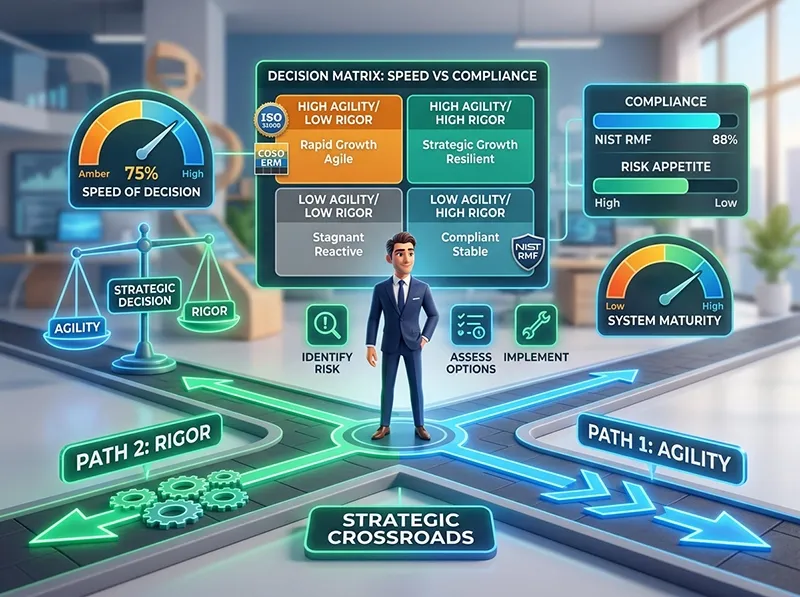
Selecting an operational model feels daunting when every corporate whitepaper claims to hold the definitive answer. In my own consulting work with independent creators and high-stakes operators, the mistake is rarely choosing the wrong framework. The real disaster is adopting an enterprise-grade engine without understanding its intrinsic trade-offs or cognitive costs.
To make an honest decision, you must evaluate what each standard optimizes for and where it inevitably stumbles.
Comparative matrix: Goal, strengths, and limits
ISO 31000: Principles over prescriptions
- The Core Goal: Embedding iterative uncertainty checks into baseline decision loops.
- Strengths : It is extraordinarily lightweight and adaptable. It reframes deviations as potential upside rather than mere existential threats, making it perfect for volatile creative careers.
- Limits: It provides zero prescriptive checklists. If you lack disciplined self-direction, its abstract principles can easily dissolve into vague good intentions without tangible outcomes.
COSO ERM: Strategic alignment and governance
- The Core Goal: Harmonizing organizational appetite with forward-looking operational bets.
- Strengths: It forces ruthless realism regarding your true capacity for loss, preventing you from over-leveraging time, emotional capital, or capital reserves.
- Limits: It carries noticeable administrative weight. Treating everyday pivots like boardroom committee reviews paralyzes rapid iteration and suffocates daily spontaneity.
NIST CSF 2.0 & RMF: Resilient outcome systems
- The Core Goal: Technical continuity and structured response loops when defenses fail.
- Strengths : It removes the illusion of absolute prevention, establishing rapid detection protocols that safeguard digital assets and personal operational sanity.
- Limits: It easily induces control fatigue. Over-engineering fail-safes for minor disruptions wastes precious bandwidth that belongs to deep, creative production.
The “too many tools” trap: Knowing when to stop planning
The most insidious trap in modern strategy is mistaking operational setup for genuine progress. I have watched talented founders spend three consecutive weeks color-coding complex Notion dashboards, convince themselves they were derisking their future, and then abandon the system the moment an unexpected client fire broke out.
A framework should resemble a lean steering mechanism, not an obstacle course. When you track dozens of micro-variables, the friction of maintaining the model overwhelms the actual execution. The rule of thumb is direct: if your review routine demands more than fifteen minutes a week, you are managing admin anxiety, not real-world risk.
Personal ERM: Turning Enterprise Thinking into a Weekly System
Corporate models fail in ordinary routines because they were engineered for compliance committees, distributed liability, and board sign-offs. An individual operates under radically different physics: limited energy, finite attention spans, and single points of emotional fatigue. Personal ERM strips out corporate pomp and isolates the core metabolic engine of risk strategy.
It acknowledges that you cannot insulate yourself from all turbulence. Instead, it creates a sustainable rhythm that catches catastrophic threats early while keeping daily execution light and agile.
The minimalist 10-minute risk register and barbell review routine
Your personal register requires only three lines on paper: your single critical priority, the primary external shock that could sink it, and the immediate buffer you hold in reserve. When it comes to personal stability, sound money management serves as that fundamental cash cushion, giving you the runway to ignore petty market shocks and stay strategically calm.
The review itself runs on Nassim Taleb’s barbell principle: extreme hyper-conservatism on absolute downside risks paired with extreme aggressive freedom on creative upside bets.
Every Sunday evening, spend six minutes identifying what could permanently break your foundation—financial vulnerabilities, critical single points of failure, or looming health burnout. Lock down protective buffers for those non-negotiables. Then, spend your remaining four minutes deliberately releasing control over smaller, chaotic daily variables. You preserve your downside completely, freeing your creative energy to chase high-reward outcomes without dread.
Conclusion
Mastering uncertainty does not require corporate bureaucracy; it simply demands an operational architecture built for reality. By adopting an agile integrated risk management mindset, drawing strategic alignment from the COSO ERM enterprise risk management framework, and applying the iterative resilience of ISO 31000 and NIST, you stop reacting blindly to daily chaos. A minimalist personal GRC framework protects your critical vulnerabilities, freeing your attention to pursue bold opportunities without fear of sudden ruin.
Was this article helpful?
Next Article
Smart Home Ideas for 2026: 16 Practical Ideas for New Construction and Everyday Living
Comments(0)
Be the first to leave a comment.