
A connected home is no longer a futuristic concept; it has settled into our daily routines. Yet in so many living rooms, people still juggle multiple remotes just to shut off lamps or toggle an AC unit. Most people believe exploring modern smart home ideas simply means buying expensive gadgets and connecting them to Wi-Fi. That mindset usually creates more digital clutter than actual comfort.
Over years of setting up connected spaces, I have watched countless households become more complicated instead of smarter. Technology without an intentional system creates friction. When you have to open three different apps just to dim the living room lights for a movie, the system has failed. Useful automation should remove manual steps, not introduce extra screens.
The most effective smart home ideas for everyday life are quiet, reliable, and invisible. They solve real annoyances and organize your living space effortlessly. Whether you are planning smart home ideas for new construction before the drywall goes up or tuning an existing home, the objective remains simple: build dependable routines that make daily life smoother, safer, and entirely stress-free.
The 2026 Shift: Grounding Smart Home Ideas in Everyday Utility
Finding genuine value in modern smart home ideas requires looking beyond standard novelty. Years ago, my wife and I bought an empty apartment shell and decided to install modern lighting systems from scratch. We installed an automated island pendant, recessed linear accent runs, and a motion-triggered entryway frame that glowed gently during midnight kitchen walks. That hands-on build proved that true home automation ideas must serve daily movement naturally rather than forcing you to constantly navigate cluttered touchscreens.
Disconnected Gadgets vs. Purpose-Built Living Systems
Smart house automation ideas quickly collapse into daily friction when you rely on isolated gadgets. When my wife and I planned our lighting, we skipped stand-alone devices that required proprietary remotes or dedicated smartphone apps. Real-world living taught us that managing five different wireless bridges leads to constant troubleshooting and annoying operational lag. A unified smart home technology system connects every circuit silently, removing cognitive weight so family members interact with spaces effortlessly without thinking about device connectivity.
Feature / Metric | Fragmented Cloud Gadgets | Unified Local Infrastructure |
System Control | Dependent on external cloud servers | Instant execution via local-first hubs |
Network Hygiene | Crowds personal 2.4GHz Wi-Fi channels | Segmented VLAN / Thread mesh paths |
User Experience | Multiple apps and inconsistent remotes | Unified wall switches and ambient triggers |
Outage Resilience | Automations stall when broadband drops | Routines run offline without interruptions |
The Three Non-Negotiables: Local Reliability, Matter over Thread, and Network Hygiene
The best smart devices work reliably only when built on a solid network foundation. Nothing breaks daily routines faster than an external internet outage disabling your hallway lighting or morning climate controls. Modern deployments must prioritize local-first processing through Matter over Thread protocols alongside a dedicated IoT virtual local area network (VLAN). Isolating connected devices keeps your personal data safe, reduces Wi-Fi interference, and ensures your essential automation routines execute instantly without leaking internal traffic to third-party servers.
Smart Home Ideas for New Construction: The Pre-Wire & Electrical Rough-In
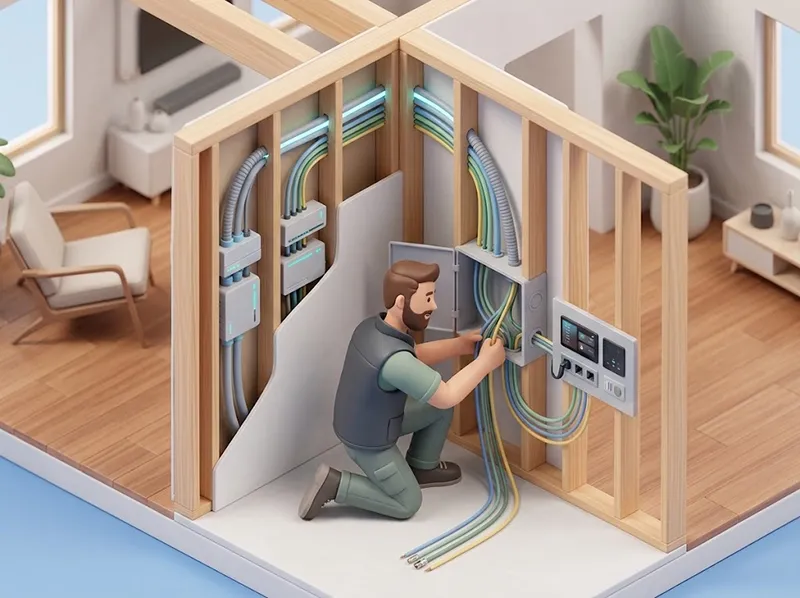
I learned the real value of smart home ideas for new construction only after our first apartment was finished. Tackling smart home construction after move-in meant cutting into fresh plaster. A dependable living space requires purposeful smart house design, planning your new construction electrical rough-in before sheetrock goes up. Getting your smart home wiring and new home wiring right during this phase creates permanent low-voltage pathways, turning standard builds into high-performance homes.
1. Dedicated Neutral Wiring in Extra-Deep Gang Boxes
- Practical Problem: In standard wiring a new house projects, electricians use shallow boxes. Once wire nuts are packed inside, you have zero room for relays. Cramming parts creates high heat, pinches copper conductors, and causes physical switch failures.
- Infrastructure Solution: As part of modern smart house wiring, pull a dedicated neutral to every switch and specify extra-deep (68mm) enclosures. This provides safe thermal dissipation and easily fits micro-modules behind standard toggles.
2. Structured Cat6A Low-Voltage Drops and Strategic PoE Access Points
- Practical Problem: Relying on wireless bands for 4K cameras and streaming hardware clogs the 2.4GHz spectrum. This wireless congestion causes automation lag, packet drops, and frequent connection timeouts on personal devices.
- Infrastructure Solution: Essential new home tech means pulling dual shielded Cat6A cables to media hubs and ceiling points for PoE access points. Hardwiring heavy data paths leaves wireless channels clear for low-draw sensors.
3. Hardwired Line Voltage for Motorized Window Coverings
- Practical Problem: Battery-powered shades drain unexpectedly, forcing you to pull out tall ladders and charge motors individually. If batteries fail during vacations, automated thermal control and privacy routines stop functioning entirely.
- Infrastructure Solution: Integrate dedicated low-voltage wiring into your smart home electrical layout right at the window framing headers. Hardwired power ensures quiet, coordinated daily shade adjustments across wide architectural glass without maintenance.
4. Continuous 16–24V Power Infrastructure for Video Entry
- Practical Problem: Battery-powered video doorbells enter sleep states to save power, resulting in slow wake-up latency. You end up missing visitors, experiencing delayed notifications, and dealing with broken two-way audio conversations at the door.
- Infrastructure Solution: Modern smart home technology ideas require continuous 16–24V AC transformer lines pulled directly to the front entryway. Continuous voltage keeps optical sensors alert, eliminates video streaming delays, and prevents dropped indoor chimes.
5. Smart Electrical Sub-Panels with Circuit-Level Monitoring
- Practical Problem: Traditional breaker panels cannot show phantom energy drains. They leave homeowners completely unaware of failing appliances until an aging compressor draws excessive amperage and suddenly trips the main breaker.
- Infrastructure Solution: Install an intelligent smart home electrical panel during your rough-in electrical phase. Breaker-level energy telemetry detects abnormal electrical draws, tracks utility costs in real time, and automates high-load appliance shedding during peak hours.
6. Main Water Supply Auto-Shutoff with Integrated Manifold Placement
- Practical Problem: Plumbing leaks behind kitchen cabinets or under appliances cause disastrous structural damage within minutes. If a pipe ruptures while you are away, standard insurance policies rarely cover the full restoration headache.
- Infrastructure Solution: Plumb a motorized automatic shutoff valve directly onto the main water intake manifold. Pairing this hardwired valve with floor-level sensors executes instant, local shutoffs without needing active cloud or internet connections.
7. Continuous Smurf Tube (Conduit) Pathways Across Core Hubs
- Practical Problem: Drywall permanently seals wall studs after inspection. When future networking standards or fiber optic cables arrive, running new lines requires cutting walls, patching plaster, and repainting entire living spaces.
- Infrastructure Solution: Run 1.5-inch flexible conduit (smurf tube) between the entertainment wall, equipment rack, and attic. Pull strings left inside simplify retrofits whenever evolving connected-living standards require clean physical line replacements.
8. Interconnected Hardwired Smoke and CO Detection with Smart Relays
- Practical Problem: Standalone battery-powered alarms only alert the immediate room where smoke gathers. They cannot trigger visual egress pathways or shut down ventilation fans to prevent dangerous fumes from circulating.
- Infrastructure Solution: Interconnect all 120V safety detectors and bridge them to a dedicated dry-contact relay. When triggered, the system instantly cuts HVAC fans, unlocks exterior access doors, and turns interior lighting to full brightness.
Field-Tested Build Tip: The Rough-In Protocol
Running line-voltage Romex directly alongside low-voltage Cat6A inside the same wall bay generates electromagnetic interference that cripples data throughput. Keeping high-voltage runs and network lines at least 12 inches apart—and crossing them only at strict 90-degree angles—is one of the most effective physical [Risk Management Frameworks] you can use during rough-in wiring to eliminate ghost triggers.
Practical Smart Home Ideas for Everyday Living: High-Yield Automations
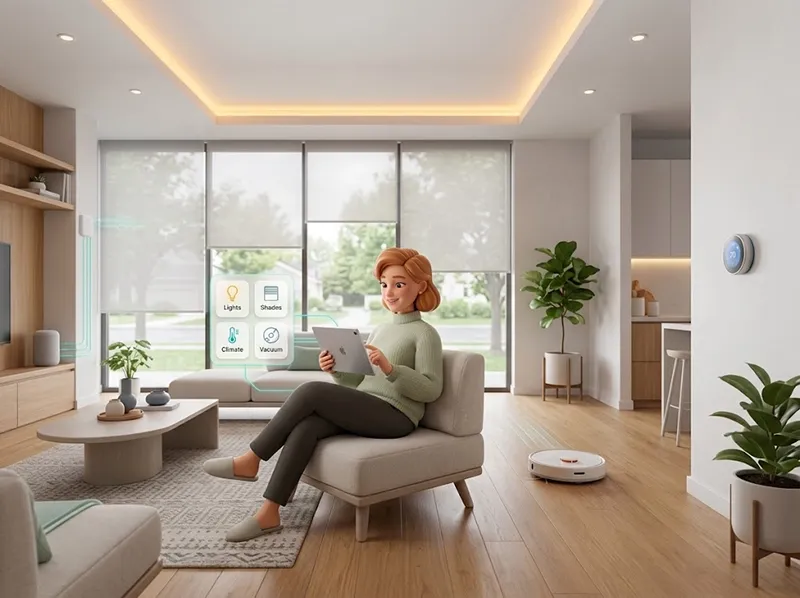
Once the drywall is painted and the dust settles, exploring everyday smart home ideas stops being about wires and becomes about how your day actually feels. When my wife and I finally moved into our new place, I made the classic enthusiast mistake: I automated everything simply because I could. I had sensors beeping at odd hours and phones pinging over trivial updates. It took several weeks of frustrated troubleshooting to learn that the best smart home automation ideas are completely quiet. Genuine home routines shouldn't demand your attention; they should lift subtle mental burdens so you can simply live.
9. True "Away" Perimeter Lockout and Environmental Setback
- Practical Problem: Leaving the house always used to trigger a loop of minor doubts. Did I lock the side door? Is the patio slider latched? Did we leave the AC blasting in the guest room? Manually checking every corner wastes time and spikes utility bills when cooling runs for an empty house.
- Trigger $\to$ Action $\to$ Real-World Utility: When the system senses our phones clear the neighborhood boundary, it takes over. The motorized deadbolts slide shut, exterior motion cameras arm, and the thermostats shift into an energy-saving setback mode recommended by the Department of Energy (DOE). You drive away knowing the house is locked down and not burning money.
10. Circadian Color Shifting Linked to Astronomical Clocks
- Practical Problem: Harsh, blue-tinted overhead lighting (around 4500K) running late into the evening tricks your brain into thinking it is still noon. It silently ruins your natural wind-down routine and keeps you staring at the ceiling when you should be drifting off to sleep.
- Trigger $\to$ Action $\to$ Real-World Utility: By tying indoor smart lighting to an astronomical clock, the color temperature changes on its own throughout the day. You get crisp, energizing light around noon, which gradually shifts to a soft, amber 2200K glow by dinnertime. It helps your biological clock adjust without you ever touching a dimmer switch.
11. Static Presence Sensing via mmWave Radar
- Practical Problem: Traditional motion sensors (PIR) are infamous for plunging you into darkness the moment you sit still to read or work at a desk. Having to wave your arms in the air every ten minutes just to turn the office lights back on is the opposite of living smartly.
- Trigger $\to$ Action $\to$ Real-World Utility: Upgrading key areas with mmWave radar sensors solves this instantly. Because these modules detect micro-movements like breathing and slight finger taps, the lights stay on as long as you are seated, and shut off naturally only after you truly leave the room.
12. Progressive Morning Wake Sequences with Thermal Buffering
- Practical Problem: A screeching smartphone alarm jolting you out of deep sleep is a miserable way to start any day. If the bedroom is uncomfortably freezing, getting out from under the covers feels like an uphill battle that throws off your entire morning momentum.
- Trigger $\to$ Action $\to$ Real-World Utility: Half an hour before you need to get up, the bedroom heating nudges the ambient temperature to a comfortable level while motorized shades slowly roll open by small increments. Waking up to soft natural light and a warm room lets you start the day calmly rather than in a rush.
13. Demand-Driven Indoor Air Quality Flushing Loops
- Practical Problem: Trapping indoor air in modern, airtight homes allows cooking fumes, volatile organic compounds (VOCs), and carbon dioxide to build up quickly. Leaving large exhaust fans running 24/7 wastes electricity, yet manually remembering to turn them on always happens too late.
- Trigger $\to$ Action $\to$ Real-World Utility: Dedicated air quality sensors continuously track particulate spikes and $\text{CO}_2$ buildup. When you sear food on the stove or host friends in the living room, the system detects the spike and ramps up fresh air ventilation, quietly clearing the air and easing back down on its own.
14. Off-Peak Dynamic Load Shifting for High-Draw Appliances
- Practical Problem: Major household equipment—like water heaters, dishwashers, and electric vehicle chargers—draw massive amounts of electricity. Running them indiscriminately during peak afternoon and early evening hours means paying top-tier utility rates for no good reason.
- Trigger $\to$ Action $\to$ Real-World Utility: You can set high-draw devices to communicate with off-peak power schedules. The dishwasher delay-starts at midnight, and the car charges during the cheapest early-morning window, cutting your monthly utility expenses without altering how you use the house.
15. The Single-Action "Goodnight" Perimeter Lockdown
- Practical Problem: Doing the nightly round—walking down dark hallways, double-checking every lock, checking that the garage door is down, and clicking off forgotten lamps—turns an evening wind-down into a tiring security chore.
- Trigger $\to$ Action $\to$ Real-World Utility: We mounted a discreet button right by the bedside. One single tap turns off every stray light, confirms all exterior doors are bolted, closes the garage, and gives a faint green glow on a small indicator light so you can close your eyes with complete peace of mind.
16. Dynamic, Pattern-Derived Occupancy Emulation
- Practical Problem: Basic mechanical timers that click the living room lamp on at exactly 7:00 PM and off at 10:00 PM look rigid and obvious. Anyone watching the street for a couple of nights can easily tell the house is sitting empty while you are out of town.
- Trigger $\to$ Action $\to$ Real-World Utility: A well-designed vacation automation replays your family's actual lighting patterns from the past couple of weeks, adding random, natural minute offsets. To anyone outside, the home looks naturally lived in, with lights and shades operating just as they would if you were sitting on the couch.
Prioritizing Upgrades: What to Build In vs. What to Add Incrementally
When budgeting, the sharpest smart home ideas separate messy structural rough-ins from simple surface hardware. Prioritize permanent conduits, deep electrical boxes, and wired shutoff valves before sheetrock seals your walls. You can easily add smart bulbs, presence sensors, or emerging [AI Applications in Daily Life] down the road without tearing open ceilings. Protecting your capital means investing heavily in hidden low-voltage infrastructure while treating tabletop gear as flexible plug-and-play accessories.
Category / Phase | High-Impact Build-In (Messy & Permanent) | Incremental Add-On (Flexible & Surface) |
Core Upgrades | Neutral wires, Cat6A drops, PEX shutoff valves | Smart plugs, table lamps, wireless buttons |
Upgrade Strategy | Non-negotiable during framing and rough-in | Install gradually as daily needs dictate |
Obsolescence Risk | Extremely low (Copper & conduit last decades) | Medium (Radios and protocols iterate fast) |
Everyday Practicality: Making Technology Serve the Home
At its foundation, exploring smart home ideas is never about hoarding gadgets to show off to friends; it is about lightening your everyday mental load. A well-designed home does not ask you to manage complicated dashboards or argue with voice assistants. It simply operates quietly in the background, matching your natural cadence, locking doors when you leave, and softening the lights when you unwind—delivering calm order without demanding your attention.
Conclusion
Building a living space that feels calm and effortless does not happen by accident; it starts with clear intention. The most enduring smart home ideas are not the ones that demand your constant attention or fill your smartphone with endless push notifications. When you get the hidden pre-wiring right during construction and implement only the automations that genuinely remove everyday friction, technology stops feeling like a chore and fades into the background—quietly supporting your daily rhythm so you can focus on simply living.
Was this article helpful?
Next Article
Automate Personal Financial Planning with Smart Software & Best Apps
Comments(0)
Be the first to leave a comment.