

Most people do not lack time. Their attention gets split across urgent demands, household duties, and digital noise. For years, I treated productivity like an engineering puzzle and assumed that filling every hour guaranteed results. It did not. What helped was replacing a rigid schedule with a realistic plan. In this guide, you will find practical time management tips that show how to manage your time, organize your daily schedule, and protect room for what matters most.
Understanding Time Management and Why It Matters
Most people think of time management as an aggressive corporate sprint, filled with back-to-back calendar invites and urgent deadlines. In reality, how you structure your hours shapes your entire well-being. Practicing effective time management gives you clear boundaries instead of a packed agenda. It creates intentional space where personal obligations, career goals, and quiet evenings coexist naturally, turning an overwhelming daily schedule into a sustainable, repeatable rhythm you can actually maintain.
What Is Time Management in Everyday Life?
Time management in everyday life is the process of deciding how to use your available time across work, household responsibilities, personal commitments, rest, and meaningful activities. It is not about controlling every minute of the day. It is about creating enough structure to make better decisions while leaving room for real life.
Daily time management covers far more than your desk tasks. A standard day also includes preparing meals, exercising, spending time with family, and pursuing personal goals. When these competing demands fight for the same limited hours, unfinished obligations often spill into your rest. Practical planning helps you see the complete picture and prioritize where your energy belongs first.
Time management is also an important part of organizing your responsibilities, priorities, and everyday decisions. Many people treat it strictly as an office skill, but time management for life is much broader than that. Learn more about what life management means and how it can help you build a more intentional daily routine.
Why Time Management Skills Matter
Strong time management skills do not necessarily mean completing more tasks every day. They help you decide what deserves your attention, what can wait, what can be simplified, and when you need to pause. This makes it far easier to manage work and personal life without treating every single responsibility as an immediate crisis.
In practice, this approach eliminates the constant mental fatigue of carrying open loops in your head. When tasks are organized clearly, you forget fewer commitments, make decisions without second-guessing yourself, and recover true downtime. In my own routine, the biggest shift came when I stopped trying to do everything faster and focused on eliminating unnecessary obligations before the week began.
10 Practical Time Management Tips for Daily Life

Effective time management tips do not require complicated apps or extreme discipline. Most productivity systems fail because they assume your day runs like a factory line. Real life includes delays, fatigue, and family obligations. The goal is a system that bends without breaking. Here are ten field-tested time management techniques for building a realistic daily schedule and learning how to manage your time with less stress.
1. Track How You Spend Your Time
Before you change anything, find out where your hours actually go. Run a three-day time audit and write down what you do every hour on a notepad. Three days is enough to reveal patterns, and it is far less exhausting than tracking for a month.
Pay attention to micro-leaks: scrolling between meetings, switching between email tabs, or checking your phone without a clear reason. Most people discover that they do not lack time. They lose it in small, repeated distractions they never noticed.
2. Choose Your Top Three Priorities
Long to-do lists create paralysis. In Essentialism, Greg McKeown points out that “priority” was singular for centuries, meaning one thing. When everything becomes a priority, nothing does.
Choose three core outcomes each morning and finish them first. Let minor tasks wait without guilt. Three clear wins by noon will do more for your momentum than twenty half-finished items.
3. Create a Realistic Daily Schedule
A rigid schedule breaks at the first delay. Use the 75% capacity rule: plan only about three-quarters of your available hours. The remaining quarter absorbs traffic, unexpected calls, and tasks that take longer than expected.
A realistic daily schedule does not squeeze output from every hour. It expects interruptions and gives you room to handle them calmly.
4. Use Time Blocking for Important Tasks
Assign specific blocks on your calendar for home, work, focus sprints, exercise, and personal time. Start with two or three blocks, not ten. Grouping your day into clear containers removes the daily question of what to do next.
A simple planner makes priorities, appointments, and personal responsibilities visible in one place. If you prefer a low-tech method, learn how to organize your life with a paper planner.
5. Group Similar Tasks Together
Switching between unrelated chores drains mental energy. Batch low-focus admin work, such as answering emails, paying bills, sorting mail, and making calls, into one 45-minute block.
When administrative tasks share one container, they stop interrupting deeper work. You also finish them faster because your mind stays in the same mode.
6. Break Large Tasks Into Smaller Steps
Vague projects trigger procrastination because your brain cannot see the first move. Replace “organize the garage” with “sort tools into one bin.” Replace “write the report” with “outline the first three headings.”
Small starting actions reduce inertia and build momentum quickly.
7. Set Time Limits for Low-Priority Tasks
Parkinson’s Law states that work expands to fill the time available, and routine chores follow the same pattern. Give a room an open afternoon, and it can take the entire afternoon. Set a 20-minute timer, and you act with urgency.
Use firm limits for minor tasks so housekeeping does not swallow your evening.
8. Reduce Digital Distractions
Relying on willpower alone against notifications is a losing battle. Build friction instead. Switch your phone to greyscale, charge it outside your bedroom, and turn off non-essential alerts during focus hours.
Less constant visual noise makes it easier to return to deep focus after an interruption.
9. Stop Multitasking
Doing several things at once is mostly an illusion. The American Psychological Association has reported that frequent task switching can reduce productivity by as much as 40 percent. Each switch leaves part of your attention behind, so the next task starts with less focus.
Work on one task from start to finish. You will usually finish faster and make fewer mistakes.
10. Schedule Breaks and Personal Time
Rest is an operational need, not a reward for overwork. Without scheduled downtime, your mind takes unplanned breaks through aimless scrolling and mental fatigue.
Treat evening walks, workouts, and quiet time with the same commitment you give a professional appointment. Your energy is part of your schedule, and it deserves a place in it.
Productivity vs. Reality: Everyday Planning Breakdown
Rigid Corporate Approach | Resilient Everyday Approach |
|---|---|
Schedules every minute from 8 AM to 8 PM | Plans about 75% of available time, leaving buffer |
15-item daily lists that create guilt | Three priorities completed first |
Constant multitasking across screens | Dedicated single-task time blocks |
Rest happens only after burnout | Breaks are scheduled before fatigue sets in |
Common Time Management Mistakes

A schedule can look productive on paper and still fail in real life. If every minute is assigned to a task, one delay can disrupt the entire day. Effective time management requires structure, but it also needs flexibility. Many issues start with small habits that seem harmless at first. Here are the mistakes I see most often, and the ones I used to make myself.
Creating an Unrealistic To-Do List
A to-do list with fifteen items feels ambitious in the morning and discouraging by evening. Most of those tasks were never realistic for a single day. When I wrote lists like this, I finished only a fraction and felt behind before noon. Estimate the actual hours needed, then list only what fits. A short list you finish is far more useful than an endless one you abandon.
Filling Every Minute of the Day
Packing every hour leaves zero margin for the unexpected. A ten-minute delay in traffic or an urgent call can push back every obligation after it. People then feel they failed, even though the schedule was fundamentally flawed. Leave intentional gaps between activities. Those gaps absorb delays and small emergencies, so a single bump does not ruin your entire schedule.
Ignoring Rest and Transition Time
Moving between different responsibilities requires cognitive reset time. When you jump straight from an intense meeting into household chores, you carry residual tension with you. Rest is an operational necessity, not lost time. Build short pauses into your day, such as a five-minute walk or stepping away from your desk. These brief resets help you enter the next task with a clear mind.
Trying to Multitask
Replying to messages while trying to draft a report feels fast, but it slows both tasks down. Your focus fractures with every switch, and error rates climb quickly. Choose one task for a dedicated focus block, finish it, and then move on. Single-tasking remains one of the most reliable time management strategies because it eliminates the hidden cognitive drag of constant task-switching.
Using Too Many Productivity Systems
I once tried running three planning apps at the same time: one for daily habits, one for project tasks, and another for notes. Within a few weeks, maintaining the software took more energy than doing the actual work. Stick to one central place for tasks and one calendar. A simple setup you use consistently beats a sophisticated system you abandon by Friday.
Confusing Busyness With Progress
A full day does not automatically mean a productive day. Sorting minor emails, shuffling papers, and running small errands can consume eight hours without moving your primary objectives forward. At the end of each afternoon, evaluate what actually created meaningful progress. If the answer is vague, adjust your priorities before tomorrow begins so you know how to improve time management in your everyday workflow.
Failing to Adjust the Plan
Plans break because life is fluid. Emergencies surface, projects expand unexpectedly, or personal energy dips. When you treat a schedule like stone, you end up feeling guilty for normal disruptions. Review your layout weekly. Notice what worked, what failed, and adapt accordingly. A system that bends to reality is the only kind that lasts.
Treating Every Task as Urgent
When everything feels like an emergency, nothing receives the deep attention it deserves. Urgent demands yell the loudest, but important duties determine long-term progress. Most people spend their days reacting to external requests instead of their own goals. Separate immediate demands from truly meaningful tasks before you open your inbox so your core priorities stay protected.
Better time management is not only about adding more tasks to your schedule. It also means simplifying commitments, reducing unnecessary decisions, and making room for what matters. These ideas can help you simplify your life and build a calmer routine you can actually sustain.
A Simple Daily Time Management Routine
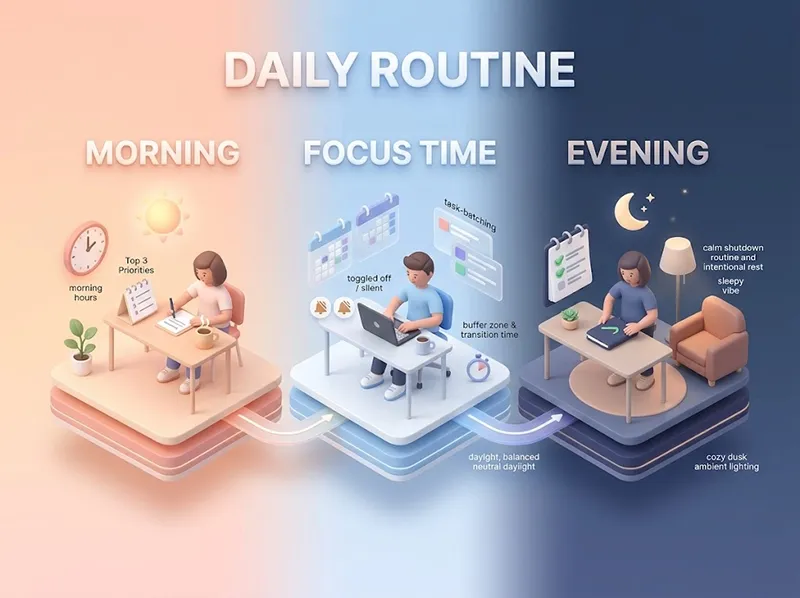
A structured day does not need to feel rigid or exhausting. A simple daily rhythm means creating three reliable checkpoints: morning, during the day, and evening. These checkpoints anchor your decisions and reduce the mental load of constantly wondering what to do next. They also leave room for real life, which rarely follows a perfect script. Use this routine as a starting point, then adjust it to your own energy and responsibilities.
In the Morning
Begin by choosing your three priorities before you check messages or notifications. Identify the single most important task that would make the day feel successful. Then estimate the real time each task requires, not the time you hope it will take. Setting your main goals early prevents you from spending the whole day reacting to other people’s urgent requests.
During the Day
Group similar administrative chores into one batch so you avoid constant switching between unrelated tasks. The NHS recommends breaking work into smaller steps and using time blocking to make plans more manageable . Protect at least one uninterrupted focus block for your hardest work, and silence non-essential alerts during that window. Keep some buffer time between commitments as well. Calls, delays, and household interruptions will happen, and a little open time helps you absorb them without losing the rest of your plan.
In the Evening
Spend five quiet minutes reviewing what you finished and marking those tasks complete. Move unfinished items to a later day without guilt, since carrying every incomplete task forward only increases pressure. Then write down two or three priorities for tomorrow morning. Regular review is a core habit in good planning guidance, and a clear closing routine keeps work thoughts from following you into dinner and rest, so your evening can truly recharge you.
Conclusion
Better time management does not require a perfect schedule or a complicated productivity system. Start by tracking how you spend your time, choosing three meaningful priorities, and building a realistic plan that includes work, personal responsibilities, rest, and flexibility. The goal is not to stay busy every minute of the day. It is to use your energy intentionally, reduce unnecessary stress, and make room for what matters most. Try one of these time management tips this week, adapt it to your routine, and build steady momentum from there.
Was this article helpful?
Next Article
Smart Home Gadgets That Make Everyday Life Easier
Comments(0)
Be the first to leave a comment.