
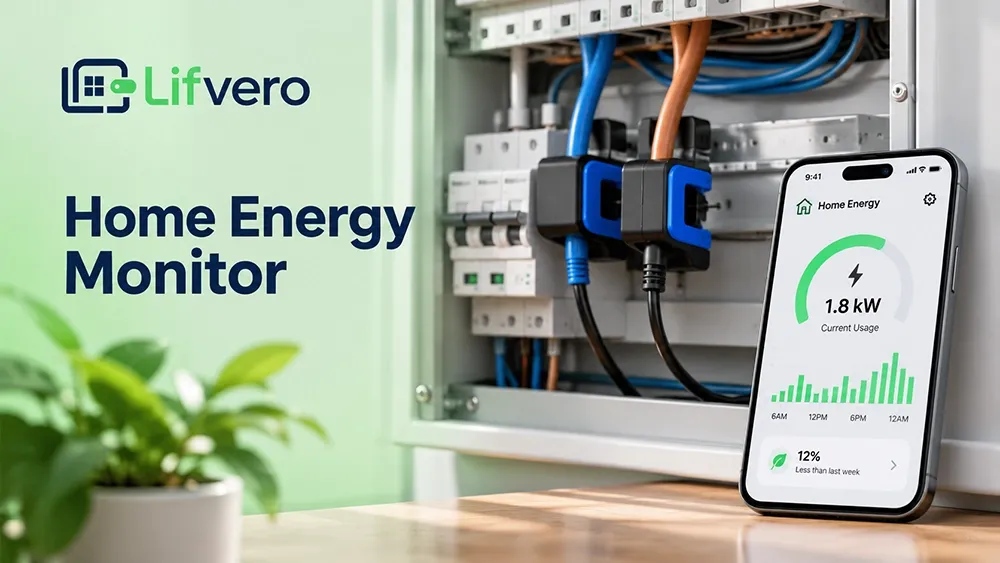
Your electricity bill arrives with one aggregate number and zero explanations. You pay it, then spend the entire month guessing whether the water heater, an old basement fridge, or an overworked air conditioner drove up the total. Without hard telemetry, every conservation attempt is just guesswork—and guesswork gets expensive quickly. That ambiguity is where most well-intentioned energy saving plans quietly fall apart.
A week of real-time home energy monitoring on my 200-amp service panel dismantled my assumptions faster than any spec sheet could. After clamping a dedicated home energy monitor inside the breaker box, I made no behavioral adjustments and simply observed the baseline load. The appliances I had suspected were innocent, whereas silent, always-on equipment sustained a stubborn vampire draw that never dipped below 180 watts, even at 3:00 AM.
An electricity usage monitor will not lower an electric bill on its own. Instead, it anchors your decisions in raw data rather than intuition. From that foundation, connected devices—like thermostats, automated controls, and smart plugs—can turn real measurements into effortless, persistent habits. That bridge between visibility and automation is the core of practical smart living and modern smart home energy.
What Is a Home Energy Monitor and Why Does It Matter?
A home energy monitor is not a smarter version of your utility meter. It is a separate measurement layer installed inside the electrical panel, reading current directly from the conductors that feed the house. That distinction matters. The utility meter reports what you are billed for; the monitor reports what is actually happening, second by second, at the point where power enters the building.
How Does a Home Energy Monitor Work?
Two split-core Current Transformer (CT) clamps sit around the main service lines. They sense the electromagnetic field created by flowing current and convert it into a proportional low-voltage signal. Nothing is cut or stripped, which keeps the install reversible and, in most jurisdictions, keeps it outside the scope of permitted electrical work.
Stage | Component | Function |
|---|---|---|
1 | Main service lines | Carry the full household load |
2 | CT clamp sensors | Convert current into a proportional signal |
3 | Transmitter unit | Samples voltage and amperage locally |
4 | Home Wi-Fi | Moves the data across the local network |
5 | Dashboard (live kW) | Displays consumption in real time |
A single pair of clamps returns whole-home totals. A multi-channel energy monitoring system adds secondary clamps on individual breakers, so heat pumps, EV chargers, and water heaters report as separate loads instead of blurring into one figure. That granularity is what separates a power monitor from a diagnostic instrument.
Sampling runs continuously, not monthly, and the gap shows up immediately in the data. Pair the readings with Smart Home Gadgets that can actually act on them — thermostats, plugs, switches — and consumption stops being invisible. Measurement alone changes nothing. Measurement wired to a controllable load changes the bill.
What Can You Learn From Home Energy Monitoring?
Raw kilowatt-hours only become useful once they are tied to a physical load. Consistent home energy monitoring surfaces anomalies a monthly billing cycle hides completely: a compressor short-cycling, a water heater firing during peak tariffs, a pump running while nobody is home.
Alan Meier’s research at Lawrence Berkeley National Laboratory put a figure on one of the most common offenders. Standby power alone typically claims 5% to 10% of residential electricity, drawn continuously while appliances sit idle.
In my own panel tests, the surprise was not the air handler. It was a basement dehumidifier whose humidistat had failed closed, pulling 480 watts around the clock — roughly $40 a month in waste that no bill line item would ever have named.
A smart meter monitor or in-home smart meter display reports total property demand and stops there. It cannot separate baseline draw from a peak spike. That separation is what an electricity usage monitor provides, and it is what turns energy consumption tracking into an operational audit rather than a monthly surprise.
How Can a Smart Home Save Energy?

Measurement without action is just a dashboard nobody checks. The real value of a connected space emerges when physical controls respond directly to data. The reliable workflow is straightforward: the monitor identifies the baseline load, an automated controller acts on it, and the next billing cycle confirms the outcome.
Without telemetry, automation is just blind guesswork managed from a phone. When properly calibrated, automated controls transform passive tracking into permanent home energy saving.
Smart Thermostats and Heating Control
A smart thermostat reduces thermal waste by aligning climate control with actual occupancy rather than fixed habits. It lowers runtime when the home empties and restores comfort before anyone returns. When integrated with panel telemetry, it proves whether climate control dominates overall draw or hides behind smaller loads.
In my own tests, panel data showed a heat pump consuming 41% of winter demand at a 21°C setpoint. Lowering the setpoint two degrees during unoccupied blocks reduced that circuit's consumption by nearly a tenth.
Achieving this required no hardware swaps—just an optimized schedule backed by data after you Install A Home Energy Monitor on the service panel. Upgrading to an energy efficient boiler with smart heating control compounds these gains, provided circuit tracking validates heating as your primary expense.
Smart Lighting, Plugs, and Everyday Habits
A smart light switch eliminates human forgetfulness by automating fixtures to occupancy and ambient daylight, while connected smart plugs isolate localized draws across entertainment and home office setups. In my configuration, four sub-monitored plugs revealed a steady 26-watt standby power baseline—a seemingly minor draw that silently accumulated 228 kWh annually across a single room.
Deploying connected home devices delivers measurable smart home energy saving only when targeting confirmed waste, making circuit telemetry essential before buying hardware.
Do Energy-Saving Devices Really Work? The Power Saver Myth
Legitimate energy saving devices for home target quantifiable inefficiencies like phantom loads or overheated zones. Conversely, hardware promising to clean incoming line voltage or magically drop bills through wall outlets fails basic electrical engineering principles.
Device Category | Operating Principle | Financial Impact |
Smart Plugs & Relays | Disconnects phantom standby power mechanically | Measurable reduction (kWh) |
Smart Thermostats | Modulates runtime via occupancy scheduling | Measurable reduction (kWh) |
Power Factor Savers | Adds passive capacitors to balance line reactance | Zero reduction on standard bills |
The physical reality is clear: residential utility meters charge strictly for real power (kilowatt-hours), completely ignoring the reactive power that a power factor saver targets. Comprehensive laboratory testing by EPRI and the University of Texas at Austin revealed that any plug-in power saver yields virtually undetectable savings—averaging between 0.06% and 0.23%—contrasting sharply with advertised claims of 30%.
The best evaluation strategy remains simple: measure the electrical baseline, introduce the hardware, and verify the delta.
Smart Home Energy Monitoring System: Features and Tools
Not every box on the shelf earns the name energy monitoring system. Some return one number per second and stop. The gap appears the first time you ask something specific — which circuit, at what hour, at what cost. The four features below are what separate a diagnostic instrument from a live novelty display.
What Should a Smart Energy Monitor Track?
A smart home energy monitoring system should answer four questions: what is drawing power now, what ran overnight, what it costs at your tariff, and when peak demand meets peak pricing. A smart energy monitor covering all four is a diagnostic instrument; one covering only the first is a novelty. Circuit channels matter most for HVAC, water heaters, and EV chargers, where a blurred total hides both fault and fix. Alerts turn an electricity usage monitor into a power monitor that reports first.
Home Energy Monitor App Features
The app decides whether the hardware ever gets used. A good home energy monitor app keeps time-of-use cost, thresholds, and live wattage on one screen without a chart tutorial. A weak energy monitor app buries the number three taps deep.
Skip anything that only mirrors your utility smart meter display; that data arrives late. Look for local storage, CSV export, and integrations that let continuous home energy monitoring drive action instead of description. An energy usage app that ends at display is energy management in name only.
Emporia Energy Monitor and Circuit-Level Tracking
The Emporia energy monitor is physical before it is clever. The Emporia Vue clamps the mains plus up to sixteen branch circuits, so circuit-level energy monitoring is measured, not inferred. A 240V heat pump and a 120V fridge report separately because they are wired separately, and an appliance fault shows up on its own channel. That verified data makes home energy management possible: you automate the right load instead of chasing breakers. The cost is panel space and install time.
Sense Home Energy Monitor and Product Reviews
The Sense home energy monitor bets the other way: two main clamps, high-frequency sampling, machine learning that separates signatures from the aggregate. Install is fast and there are no branch clamps to route. In practice the disaggregation is uneven. Resistive loads like a water heater get identified; variable-speed inverters and mini-splits do not separate cleanly.
That gap is the recurring theme in home energy monitor reviews. Any fair home energy monitor comparison comes down to hardware certainty versus install simplicity, and the choice depends on whether you need verified appliance energy monitoring or a fast, minimal install. A smart energy monitor that guesses wrong is worse than one that measures less, but truthfully. The energy tracking app matters either way.
Home Energy Management System vs. Building Energy Management System
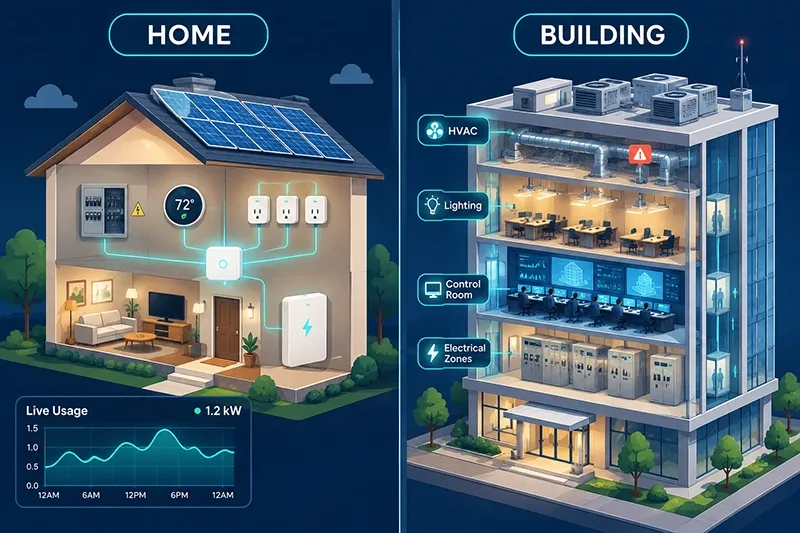
A monitor tells you what happened; a management system decides what happens next. Product catalogs often blur the distinction between passive telemetry and active intervention, steering homeowners toward expensive, unnecessary hardware before they understand the technical differences.
What Is a Home Energy Management System?
A home energy management system connects energy monitoring to devices that can adjust electricity use. Thermostats, lighting, smart plugs, appliances, solar panels, batteries, and EV chargers all fall within its reach. A basic setup might be one home energy monitor and three plugs. A fuller system coordinates several technologies at once.
What Is a Home Energy Management System?
A home energy management system bridges real-time monitoring with connected hardware that can actively adjust household electricity demand. Thermostats, lighting circuits, smart plugs, heat pumps, rooftop solar, battery banks, and EV chargers all interface within this ecosystem.
A baseline configuration might combine a single home energy monitor with several automated plugs, while complete home energy management systems coordinate diverse generation and storage assets at once. At its core, practical home energy management transforms passive data into closed-loop control, establishing a responsive smart home energy management system tailored for everyday residential energy management.
How Does a Smart Energy Management System Work?
It combines data, connected devices, and automation. Electricity prices, household schedules, solar output, and current demand feed its logic. It might shift a dryer to a cheaper hour, cut heating when the house is empty, or draw on panels when production peaks. Automation depth depends on what is connected, so start with simple controls and widen the scope only after your own usage pattern is clear.
Automation without protection is a liability.
Every controller joins your Wi-Fi, and a controller with a default password becomes the weakest door in the house. Before connecting any device, read our guide on how to secure your home, then place smart devices on a separate network.
When Do You Need a Building Energy Management System?
A building energy management system serves offices, schools, hotels, retail spaces, and apartment blocks. It coordinates HVAC, ventilation, lighting, elevators, and several electrical zones, usually through a commercial platform with dedicated controllers. Most homeowners never need that. A home energy monitor, a smart thermostat, and a few connected plugs cover the practical needs of a smart living setup.
How to Choose the Best Home Energy Monitor
Choosing the best home energy monitor comes down to panel architecture, physical space, and your actual efficiency goals — not marketing spec sheets.
Features of the Best Home Energy Monitor
The hardware is rarely the hard part. What decides the purchase is duller than the brochure:
- Panel compatibility — busbar clearance and cover depth decide whether clamps fit at all.
- Whole-home vs. circuit-level — the total shows the size of the problem; branch channels show its address.
- Local data — CSV export and LAN access outlive any vendor’s cloud.
- App quality — a home energy monitor app that buries live wattage three taps deep never gets opened.
- Refresh rate — one-second sampling catches compressor starts that sixty-second polling averages away.
Independent home energy monitor reviews keep landing on the same point: app reliability and local network support matter as much as hardware precision. A capable smart energy monitor should give peak alerts, time-of-use costing, and logs you can export without asking permission.
Plan the panel before you buy, and use practical smart home wiring design ideas — clamp sensors and transmitters need safe routing inside or beside the breaker enclosure.
Start With a Home Energy Assessment
A baseline home energy assessment comes first: thermal leaks, envelope insulation, and baseload equipment. No monitor compensates for unsealed air leaks, single-pane windows, or an obsolete furnace that needs an energy efficient boiler upgrade for real energy saving. The monitor tells you where money goes; the assessment tells you what to fix. Measure the building before you measure the circuits.
For homes with on-site generation, a smart house solar setup needs bidirectional current sensing to report honest solar savings. Automated load shifting pushes midday surplus into storage or hot water, and that timing is where smart solar savings actually accumulate. Off-grid batteries and low-voltage storage need a Victron battery monitor or Victron SmartShunt for state-of-charge tracking that no AC monitor can replicate.
Conclusion
A home energy monitor is the cheapest starting point for a smarter, leaner home. It replaces guesswork with a record of which loads run at 2 a.m., what standby power costs, and where winter bills really go. Smart thermostats, plugs, and light switches can then turn that record into daily action. Do not buy everything at once. Monitor first, find the three largest sources of waste, and buy only what addresses them. That makes smart home energy saving measurable and habitual.
Was this article helpful?
Next Article
How to Pay Off Debt Fast: A Step-by-Step Debt Payoff Plan
Comments(0)
Be the first to leave a comment.